


A few fellow historians and I from The Duffle Bag and Associates, and The American Veterans Historical Museum put together a little display for Guardian Revival’s 10th Annual Veterans Appreciation Chow Down last month.

A few fellow historians and I from The Duffle Bag and Associates, and The American Veterans Historical Museum put together a little display for Guardian Revival’s 10th Annual Veterans Appreciation Chow Down last month.
Found another one, on radio navigation in the 1940s.
Doing research for the display at FDR in 2 weeks, and I found this video.
Surfing the Net doing research for my Memorial Day display this year, and found this cool manual from the China Burma India Theater of Operations at https://cgsc.contentdm.oclc.org/digital/collection/p4013coll8.

https://www.fdrlibrary.org/events-calendar
Memorial Day Weekend Event:
World War II Military Displays
Time: 10:00 a.m. to 4:00 p.m.
Location: FDR Library Great LawnOn Saturday, May 25 and Sunday, May 26, 2024, in honor of Memorial Day Weekend, the Great Lawn in front of the Franklin D. Roosevelt Presidential Library and Museum will take on the appearance of a World War II encampment with WWII Military Displays.
Period military vehicles of all sizes and soldiers in battle dress will be on hand to share their love of World War II history. Free public event.
The Duffle Bag and Associates, along with the American Veterans Historical Museum and a host of other living historians, are doing Memorial day again at FDR, sponsored by the library. I’ll be there, weather permitting, with a small display.
Normally I do a Cold War display at FDR, despite it being predominantly a World War II themed event. There are a few of us who do a post-1945 displays there. This year however marks the 80th Anniversary of the D-Day landings in Normandy, France, and my wife and younger daughter are planning on cosplaying Rosie the Riveter (their first time going in costume for this event), so I figured it would be a good idea to have a complementary costume. I don’t think, however, that I’ll be doing an ETO impression.
Despite the amount of media play that D-Day receives, there were also other pivotal events that happened elsewhere in June, 1944. Allied forces had captured Rome in the Mediterranean Theater on June 4th. June 5th was the first B-29 bombing mission, Operation Matterhorn, in the CBI theater. June was also the beginning of Operation Forager in the Pacific Theater.
Locally speaking, many National Guard and Reserve units in this area served in the Pacific or CBI Theaters. The 77th Infantry Division (USAR), 43rd Infantry Division (CTARNG et al), 27th Infantry Division (NYARNG), 118th Observation (now Airlift) Squadron (CTANG), and 333rd (now 131st) Fighter Squadron (MAANG) all served in the Pacific or CBI Theaters. Honorable mention goes to the 98th Infantry Division (USAR) that was slated for the cancelled Operation Olympic, and served occupation duty in Japan after the war.
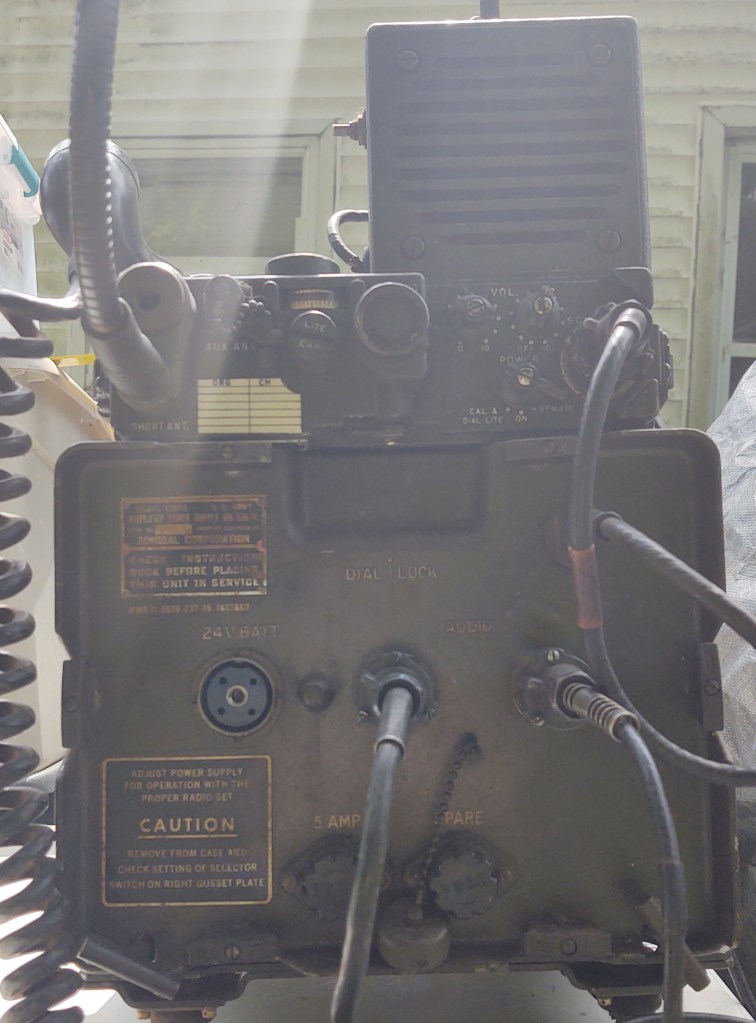
Memorial Day is next weekend, and I’ll be displaying some Cold War communications equipment at the FDR Home and Library in Hyde Park, NY sponsored by my friends and fellow historians with The Duffle Bag & Associates. I’ve done this event since I moved back East, save for when it was cancelled due to COVID.
I previously set up static displays. This year will be different as I’ll have a military shortwave receiver listening to broadcasts, and I’ll be in on the air. I’ll have a Part 15 FM broadcast station, “WFDR,” on 99.5 MHz., and a 6 Meter Amateur Radio station on 51.0 MHz. FM with my PRC-25. Hopefully the band will be open. A couple of my fellow ham operators and historians will be on HF. Callsigns and frequencies will be posted on my Facebook feed.

If you’re within driving distance of FDR come visit. My fellow historians do an excellent job of putting this event together. We’re going to have the Big Band Sound Jazz Orchestra playing on Sunday, and other family events over the course of the weekend.

I missed the past two years for Memorial Day at FDR because of COVID. Things settled down enough this year that the National Archives and the National Park Service opened it up for my associates and I this year. This time around I planned for an even bigger display than in 2019.


A line of rain and thunderstorms came through Saturday, making that day a wash (no pun intended) for the most part. Sunday was much better. I didn’t make it Saturday because of the weather, but got there early Sunday morning and set my display up.
This year I displayed three tables of radio communications and electronics test equipment covering a time span from World War II to the Cold War eras. I also set up a Part 15 FM radio station, “WFDR,” on 99.5 MHz. that played some 1940s era music for a short while.

In this picture there is a Cold War era Soviet R-105m VHF transceiver, a PRC-25, PRC-75, PRC-74, WW2 Navy/Marine Corps TBY, WW2 R-156 sonobouy receiver, and WW2 BC-1000/SCR-300.

This picture shows an early WW2 Amateur Radio station consisting of a Hallicrafters SX-25 (which did see military use during WW2) and a Utah Junior HF CW transmitter, along with a reproduction foxhole radio using an old “blue blade” safety razor blade. Unfortunately I didn’t have the space to set up a decent antenna to run the foxhole radio. Two of next years’s goals include getting reception for the foxhole radio and getting a vintage Amateur Radio station on the air.

The bottom right shows a small collection of electronic test equipment. We have a radar IFF test set, oscilliscope, VOM meter, and RF SWR/power meter.

On Memorial Day, 2019 I was volunteering as a living historian for the American Veterans Historical Museum during their annual display at the Franklin D. Roosevelt Home and Library in Hyde Park, New York. I specialize in World War II to Cold War era military communications electronics and test equipment, and curate a small collection of artifacts, ephemera, and memorabilia during events throughout the year. On that day, I was approached by a visitor who wished to make a donation for my displays. The visitor was the daughter of a U.S. Army Signal Corps officer who served in the 23rd Headquarters Special Troops, better known historically as “The Ghost Army.” The Ghost Army was tasked during the Second World War with tactical deception operations in the European Theater of Operations. The lady donated a small assortment of ephemera that belonged to her late father during his time in military service.
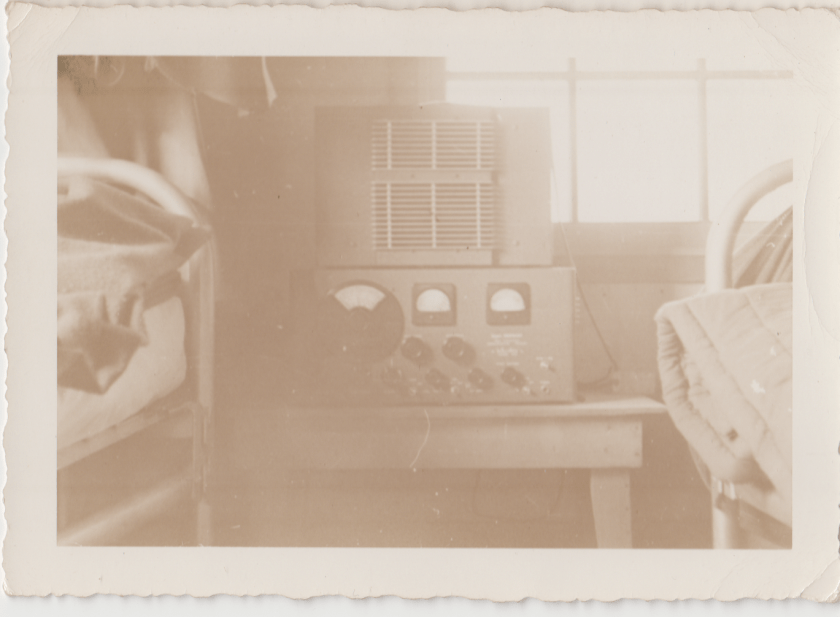
Among the ephemera donated was a 1941 dated photograph of a radio communications receiver identified as a Hallicrafters model SX-25. The SX-25 was first manufactured in 1940 just before the United States entry into the war and was considered state-of-the-art equipment at the time. It was unknown if this receiver was a personally owned item, or military issue.
Among historians, in particular living historians, attempting to portray an individual from a particular timeframe, or historians assembling a display from a particular timeframe, accuracy is essential to provide as realistic a depiction of the timeframe in question. Historians also strive to include donated artifacts in their displays as a means of thanking the donors and showing their appreciation for the gift. In the case of this donation, the donor’s late father was a member of a historically significant military unit from the Second World War, and an artifact from said donation provided a piece of data for which I was unable to find any evidence of prior research. Those two facts alone would be enough impetus for a historian to start working in order to accurately and realistically incorporate the donation into a future display.
In a conversation with historian Bob Allison of the Vintage Radio and Communications Museum of Connecticut, Mr. Allison mentioned how during the Second World War many military officers purchased communications receivers for personal use (Allison Interview). This is confirmed, albeit almost 50 years later, by my own experience. When I was on active duty during the beginning of Operation Desert Shield and Desert Storm in 1990, I purchased a shortwave radio receiver in order to stay apprised of current affairs when domestic news coverage was found to be lacking. Regardless of the SX-25’s official status, two facts are certain. The first is that it is apparent that the receiver was significant enough to the officer that it warranted being photographed. The second is that the receiver appears in some historical context, however small, related to the U.S. Army Signal Corps during the Second World War, and is therefore a worthy topic of research.
Hallicrafters was one of the first defense manufacturers of the Second World War, and their contribution to the war effort in the production of communications equipment is well documented. What is not well documented is the status of the Hallicrafters SX-25 as a military issue item. I posit that despite the lack of official documentation, the Hallicrafters SX-25 saw military service during the Second World War in a secondary or auxiliary role.
The role of Hallicrafters and the use of their products by the United States military during the Second World War is beyond dispute. Historian Chuck Dachis, the radio hobby’s recognized expert on the company and its products, wrote that “There was a shortage of military radio equipment and tremendous government demand for electronic equipment of all types. Many of the existing Hallicrafters products and designs were pressed into military service” (Dachis 9). During the war, Hallicrafters advertised their status as a manufacturer of radio communications equipment for the U.S. military and solicited service members to write about their experiences working with Hallicrafters military equipment (Radio). The Hallicrafters SX-25 was introduced in 1940 and produced until 1945 (Dachis 40). That places the production period of the receiver right at the time of U.S. involvement in the war. With the years of introduction and production coinciding closely with the year of entry into the war, combined with the early wartime stop-gap issuance of any suitable receiver design into military service, there is a strong argument towards the use of the SX-25 into military service. Further evidence however is still required for one to be certain.
One of the earliest pieces of potential evidence I encountered regarding the SX-25’s service as a military radio is a film. The United States Army Air Forces First Motion Picture Unit produced a training film, Resisting Enemy Interrogation, directed by Robert B. Sinclair. The SX-25 makes a cameo in the film as a prop used by the antagonists in the film (Sinclair). The film provides evidence that the SX-25 was procured by at least one element of the United States military, but still leaves the question of whether it was a general issue item. The United States Army Air Forces First Motion Picture Unit had a specialized function, and as a result would have been able to procure items outside regular channels in order to accomplish their mission.

The SX-25 did not just appear on the big screen. During the Second World War the U.S. Army Signal Corps used an image of a Hallicrafters SX-25 as an element in a recruiting advertisement, shown in Illustration 2 (U.S. Army). This advertisement was aimed at young men who possessed knowledge in radio and electronics. The SX-25’s presence as a prop in an official recruiting advertisement lends further credence to the SX-25’s status as a military-issue radio.
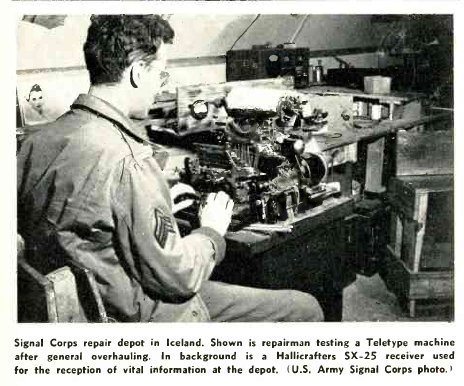
The most compelling piece of positive evidence collected by the author is an official U.S. Army photograph of a Signal Corps repair depot in Iceland during World War 2. This photograph, shown in Illustration appeared in the December 1943 issue of Radio magazine and identifies the repair depot’s radio receiver as a Hallicrafters SX-25 “used for the reception of vital information at the depot” (Radio 50). While a documented official photograph helps support an argument towards its status in military service, there should also be further supporting documentation that would define a particular item as official military issue.
The preceding evidence, despite its compelling nature, is actually of secondary veracity, and does nothing to decisively cement the status of the Hallicrafters as an official piece of military issue equipment. The receiver’s appearance among the personal effects in the living quarters of a soldier belonging to a specialized unit, its appearance in a training film, its use in an advertisement, and even its appearance in an official US Army Signal Corps photograph leave out one piece of data that is considered the primary source of authority on all things military issue.
There is a singular piece of data that will without a shadow of a doubt prove an electronic communication device’s status as official military issue. That item is a designation in the Joint Army-Navy Nomenclature System (JAN), now known as the Joint Electronics Type Designation System. Under this system, an item is giving a unique designator for identification (Mote). Once a piece of equipment is given a designator, an entire logistics chain is attached to the equipment/designator combination. Among other items in the chain is the creation of official operation and maintenance documentation for said piece of equipment. The existence of a JAN designator and operation/maintenance documentation would be the definitive evidence of a receiver’s status as an official issue item.
Hallicrafters was known for producing official issue items that were given a JAN designator in World War II. Among receivers, the Hallicrafters SX-28A, introduced in 1944, was adopted by the US Military and given the JAN designator of AN/GRR-2 (Dachis 42). The SX-25, if it were official issue, would have been given a similar designator starting with “AN/GRR.” Technical manuals would be written detailing the proper operation and maintenance for the soldiers responsible for working with and on a particular piece of equipment. Other technical manuals would be written cataloging the equipment being used by military forces. This documentation would further cement the status of a piece of equipment as an item of official issue.
I first consulted a World War II vintage War Department Technical Manual that would have provided evidence of the SX-25 receiver’s status as an official issue item. The 1944 TM 11-227 Signal Communication Equipment Directory – Radio Communication Equipment is “a condensation and compilation of data pertaining to Signal Corps radio communication equipment” (War Dept. preface). TM 11-227 documents the existence of electronic communications equipment in service as of the date of its publication. After consulting TM 11-227, I was unable to locate any mention of the SX-25 in the content of the manual.
I then searched for evidence regarding the status of the SX-25 in the 1945 War Department Field Manual FM 21-6 List Of Publications For Training. This manual was created to “provide a list and index of War Department training publications” (War Dept. 4). As with TM 11-227, I was unable to locate any mention of the SX-25 in the text. It should be noted that I did find other commercial radios manufactured by both Hallicrafters and other companies that were granted a JAN designator and noted as official issue. The civilian identity of these radios was easy to determine, so it stands to reason that the SX-25, if given a JAN designator, would also been easy to locate in the documentation. This lack of evidence argues heavily towards the Hallicrafters SX-25 Communications Receiver not being an official issue item of electronics equipment.
The SX-25 lacks a JAN designator. It also lacks a citation in TM 11-227 and lacks evidence of documentation in FM 21-6. These three items provide compelling evidence that the Hallicrafters SX-25 Communications Receiver was not an official issue military radio during the Second World War. This data, however, does not preclude instances of the Hallicrafters SX-25 being used in military service, in particular by units with a specialized mission. The lack of a JAN designator also does not rule out a particular piece of equipment being used as a stop-gap measure during the early stages of a conflict before the supply chain can provide official issue material.
In addition to documentation showing a Hallicrafters SX-25 in the possession of a Signal Corps officer assigned to the highly specialized 23rd Headquarters Special Troops “Ghost Army”, it also makes three other documented appearances in official US Army media. It makes the appearance in a recruiting advertisement for the US Army Signal Corps. It has a cameo in a film produced United States Army Air Forces First Motion Picture Unit. It lastly appears as a piece of equipment in an official US Army Signal Corps photo of a repair depot, and is specifically mention by name. Given this evidence, despite the lack of official documentation, the Hallicrafters SX-25 saw military service during the Second World War in a secondary or auxiliary role.
While the Hallicrafters SX-25 saw military service during the Second World War in a secondary or auxiliary role, this may not have been the case regarding the artifact that prompted this paper. The particular SX-25 shown in the illustration appears to be situated between two bunks. That places it in a barracks or junior officers living quarters. When this item of data is combined with the 1941 year of the picture, the 1940 year of introduction for this model, and the historical fact that the United States did not enter World War II until late in the year on December 8th, 1941, I believe that this particular SX-25 was a personal radio belonging to the officer.
One universal task of all historians, professional or amateur, is to properly document and preserve the past so it may be used as a learning tool for future generations. To achieve this end, the historian often engages in research. This research may be in regard to a minor, seemingly unimportant, but previously untouched matter such as a seemingly mundane artifact. Whatever the research might be, it helps fill in one more piece of the puzzle that is the past. If said research enables the historian to assemble an informative and educational presentation, then all the more to help the historian educate and perhaps enlighten the public. As a result of this research, I will be displaying the ephemera along with a collection of related artifacts at the Franklin D. Roosevelt home and library on Memorial Day, 2022. A Hallicrafters SX-25 will be the centerpiece of that display.
Works Cited
Allison, Bob. Personal interview. 2 Apr. 2022.
Dachis, Chuck. Radios by Hallicrafters®. Schiffer Publishing, 1999.
Hallicrafters. Advertisment. Radio, Dec. 1943, pg. 4.
Meuleman, M L. “This Month.” Radio, Dec. 1943, pp. 50–50.
Mote, Ray. “World War Two Nomenclature Systems.” Wayback Machine, Electric Radio Magazine, 6 Jan. 1994, http://web.archive.org/web/20160303174230/www.hypertools.com/nomenclature.html.
Sinclair, Robert B., director. Resisting Enemy Interrogation. Youtube, US Army Air Forces First Motion Picture Unit, 1944.
U.S. Army. “WW2 Recruiting.” Military Wives Network, www.militarywives.com/index.php/posters-menu/ww2-recruiting-museum#sigplus_1001-18.
War Department. FM 21-6 List Of Publications For Training, War Dept., 1945.
War Department. TM 11-227 Signal Communication Equipment Directory: Radio Communications Equipment, War Dept., 1944.

My favorite Army/Navy store is once again sponsoring a militaria and knife collector show next month in Patterson, NY. I’ll be in my usual spot in the corner doing a small museum display of military communications electronics and test equipment from World War II to the late Cold War era as a practice run for an upcoming event in Dutchess County, NY later this year. In addition to the vendors, there are usually other living historians attending as well. At the last show, Revolutionary War reenactors from the Living History Guild and 4th NY Regiment brought an original antique RevWar cannon. They’ll be back in April, according to the show organizer.

If you are a military history buff, this is a good show to see some neat artifacts, and maybe start a memorabilia collection. If you’re already a collector, regardless of whether your interest is the American Revolution, World War II, Vietnam, or GWOT, it’ll be at the show.
This is a family friendly event. You won’t see any of the gun show BS that you don’t want your kids exposed to. Actually, the only guns you might see there are antique muzzleloaders. So, if your kid has an interest in military history, this is a safe venue for him or her. In fact, youth will be well-represented among the living historians at the show.
Those of you using public transportation from downstate can simply get on the Metro-North Harlem line and take it up to Patterson Station. Get off the train and walk across the street. If you’re driving up from downstate, you can take I-684 up to Rt. 22, and hang a left at Rt. 311. If you’re coming in from the other side of the Hudson River, take I-84 to Rt. 311, and head towards Patterson. Coming in from Connecticut, just take I-84 to Rt.22 . Wherever you’re coming in from, it’s pretty easy to get there.
James Burrowes OAM
Keeping History Alive - 4th NY Regiment & 4th Battalion Royal Artillery
Honoring the past through excellence in the present.
Kerosene lamp restoration and other curious things.
electronics, open source hardware, hacking and more...
Photoblog of Joshi Daniel
Creating art, poetry, and fiction.
Amateur Radio stories, articles, projects, and more!
Psychological Thrillers of Strategic Justice
Fresh hacks every day
This WordPress.com site is Pacific War era information
The world's oldest and greatest name in pulp
The mindless witterings of an author at work - and play.
International wordsmiths of repute
Better than you expected.
Jake Spurlock as something subtle from the heart of Utah.
write. collaborate. win.
but do you have the courage to start?
Just another WordPress.com site
Jason Scott's Weblog
A site of endless curiosity
because anything is possible with Charisma
Just another WordPress site
Fishing, Hunting and Do It Yourself stuff
Writings of Michael Morgan
Adventures of an Imperfect Man In Search of a Handmade Life
forwards, backwards, sometimes sideways
Learn How To Survive Any Disaster Situation
"God bless it and keep it wild"
Bushcraft, wilderness survival skills and nature
Life's Little Moments
everyday and outdoor gear close to tactical and emergency
Using technology to be prepared
A few of my favorite photos
Warden of Words // Shaper of Stories
Hiking and exploring Nature's finest sculpturings
 Tom's Tech and History Blog