
Surfing the Net doing research for my Memorial Day display this year, and found this cool manual from the China Burma India Theater of Operations at https://cgsc.contentdm.oclc.org/digital/collection/p4013coll8.
Author: Tom Filecco
On the Fediverse

Memorial Day, 2024
https://www.fdrlibrary.org/events-calendar
Memorial Day Weekend Event:
World War II Military Displays
Time: 10:00 a.m. to 4:00 p.m.
Location: FDR Library Great LawnOn Saturday, May 25 and Sunday, May 26, 2024, in honor of Memorial Day Weekend, the Great Lawn in front of the Franklin D. Roosevelt Presidential Library and Museum will take on the appearance of a World War II encampment with WWII Military Displays.
Period military vehicles of all sizes and soldiers in battle dress will be on hand to share their love of World War II history. Free public event.
The Duffle Bag and Associates, along with the American Veterans Historical Museum and a host of other living historians, are doing Memorial day again at FDR, sponsored by the library. I’ll be there, weather permitting, with a small display.
Normally I do a Cold War display at FDR, despite it being predominantly a World War II themed event. There are a few of us who do a post-1945 displays there. This year however marks the 80th Anniversary of the D-Day landings in Normandy, France, and my wife and younger daughter are planning on cosplaying Rosie the Riveter (their first time going in costume for this event), so I figured it would be a good idea to have a complementary costume. I don’t think, however, that I’ll be doing an ETO impression.
Despite the amount of media play that D-Day receives, there were also other pivotal events that happened elsewhere in June, 1944. Allied forces had captured Rome in the Mediterranean Theater on June 4th. June 5th was the first B-29 bombing mission, Operation Matterhorn, in the CBI theater. June was also the beginning of Operation Forager in the Pacific Theater.
Locally speaking, many National Guard and Reserve units in this area served in the Pacific or CBI Theaters. The 77th Infantry Division (USAR), 43rd Infantry Division (CTARNG et al), 27th Infantry Division (NYARNG), 118th Observation (now Airlift) Squadron (CTANG), and 333rd (now 131st) Fighter Squadron (MAANG) all served in the Pacific or CBI Theaters. Honorable mention goes to the 98th Infantry Division (USAR) that was slated for the cancelled Operation Olympic, and served occupation duty in Japan after the war.
Military Collectors Club Show Tomorrow
I’m sad to say that my friends at The Duffle Bag have decided to close down the retail store front at the end of the month for the time being, and go exclusively with online and show sales. They also however decided to expand to monthly shows based around a military collectors club, similar to the Bay State Militaria Collectors.
I’ll give a short presentation at the show tomorrow on military radio receivers for living history displays. For more information see https://www.facebook.com/thedufflebag.

A Work In Progress
Last November I set up a small display with a few fellow enthusiasts and historians at the Veterans Chow Down held by Guardian Revival.

I usually display Cold War era radio communications equipment, and while that gear was well represented this time around, I also added some helmets, ephemera, and insignia to the display. Among the artifacts were a few Vietnam War era shoulder sleeve insignia (SSI), and a circa 1971 plaque from the 1st Calvary Division, US Army that had images of various subordinate units’ distinctive insignia. The insignia in the display prompted a few conversations from Vietnam War veterans who recognized their outfit’s patch from back in the day, and were glad to see their old outfit represented.
Based on the feedback I received from attendees, and a desire to run as light as possible (no R-390s or R-1511s LOL!) I decided to put together some Riker mounts of Vietnam War SSI for a future display. I decided to use full-color merrowed SSI for the display as they are still common and relatively inexpensive for the most part. A collector should be able to put together this display at any decent old-school army/navy store. At present my go-to place is run by my friends Brian and Jeanie, the father/daughter duo of The Duffle Bag in Patterson, NY. That’s where I do the vast majority (about 90%) of my militaria shopping. I’ve been going there since the early 1980s when the store was known as The Militaria Mart in Brewster and then Carmel, NY. It was in fact Brian who steered me towards insignia when I started collecting military memorabilia in elementary school. The Duffle Bag is at present one of the oldest and sadly one of the last old-school Army/Navy stores left in the Hudson Valley, NY region.


I referred to my copy of the late Shelby Stanton’s Vietnam Order Of Battle. Stanton’s book is one of my go-to references. I discovered that I was most of the way towards having a complete collection of authorized, merrow-edged, full-color Vietnam War SSI. The missing insignia were procured down at The Duffle Bag, along with a large Riker mount. I started arranging the patches, and discovered I need a few more mounts to cleanly display the complete set.

First Row (Left to Right): 1st Armored Division, XXIV Corps, 2nd Armored Division, 196th Infantry Brigade, 11th Infantry Brigade, 199th Infantry Brigade, 198th Infantry Brigade, 1st Calvary Division.
Second Row (Left to Right): 18th Engineer Brigade, 20th Engineer Brigade, Capital Military Assistance Command, Criminal Investigation Division, 38th Infantry Division, 101st Airborne Division (Airmobile/Air Assault), 18th Military Police Brigade, 11th Armored Calvary.
Third Row (Left to Right): US Army Special Forces, 124th Transportation Command, 5th Transportation Command, 125th Transportation Command, 82nd Airborne Division, 173rd Airborne Brigade, 4th Transportation Command, 44th Medical Brigade.
The infantry units will get separated into another Riker mount, possibly two of them if the arrangement looks crowded. The other units will be arranged in their own mount. I might also add a few twill cut-edge subdued SSI.
Full-color SSI were used on the green Army Dress Uniforms from World War 2 until 2015, and started again in 2018 with the retro-WW2 style uniform. Collectors are still finding NOS boxes of WW2 era SSI. Late 60s to present day merrow-edged SSI are common and you can buy them from 50 cents to a few dollars each depending on where you’re getting them, and which unit you’re buying. If you are a military history buff with an interest in collecting memorabilia, insignia is a good, inexpensive way to start that doesn’t take up much space. The World War 2 stuff is beginning to gain some serious value. Common patches are hitting the $10+ range compared to their cost back in the 80s and 90s. The more common late Cold War to present day stuff is still reasonably priced, and a good place to start.
The US Army Wikipedia entry shows an overview of branches of service and major units along with their respective insignia. If you delve into the individual unit wiki entries you will discover what subordinate units are part of the division/command/brigade/et al and see the unit crests (distinctive unit insignia) of the various regiments. Some of those regiments go back to the American Revolution. After collecting Vietnam War era SSI, you could work on regimental DUIs with Colonial American roots. You could also switch services and collect Navy ratings or Air Force unit patches. Yeah, there’s a lot you can get into, and that’s part of the fun. I’ve been collecting for over 40 years and am not even close to finished. Collecting military heraldry is truly a lifetime hobby.
News Release: FDR Home & Library Memorial Day Weekend Events Announced
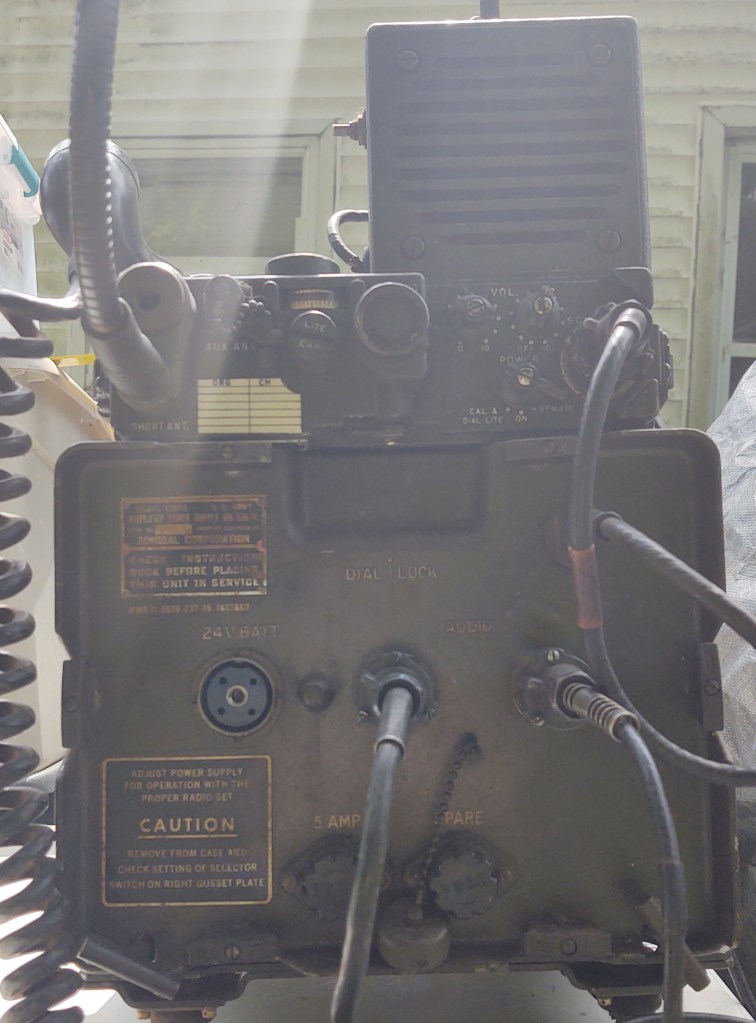
Memorial Day is next weekend, and I’ll be displaying some Cold War communications equipment at the FDR Home and Library in Hyde Park, NY sponsored by my friends and fellow historians with The Duffle Bag & Associates. I’ve done this event since I moved back East, save for when it was cancelled due to COVID.
I previously set up static displays. This year will be different as I’ll have a military shortwave receiver listening to broadcasts, and I’ll be in on the air. I’ll have a Part 15 FM broadcast station, “WFDR,” on 99.5 MHz., and a 6 Meter Amateur Radio station on 51.0 MHz. FM with my PRC-25. Hopefully the band will be open. A couple of my fellow ham operators and historians will be on HF. Callsigns and frequencies will be posted on my Facebook feed.

If you’re within driving distance of FDR come visit. My fellow historians do an excellent job of putting this event together. We’re going to have the Big Band Sound Jazz Orchestra playing on Sunday, and other family events over the course of the weekend.
Patterson, NY Militaria Show April 22, 2023

Spending part of the day finishing my packing for my friends’ militaria show next weekend. I’ve got an excess of stuff, so I’ll have my usual corner table next to the bleachers.

So far I’ve got three Sterlites full of stuff. I’ll have some French & Indian and Revolutionary War books, military TMs, military electronics, and other items Here’s a sneak peak:

Patterson Militaria Show
APRIL 22, 2023
Militaria, & Knife Collector’s Show
https://www.thedufflebaginc.com/militaria-show
SHOW HOURS 9AM-3PM
Admission: $7.00 at the door.
(Children under 12 admitted free with paid adult).
Join the Duffle Bag Saturday, APRIL 22, for its annual Militaria, & Knife Collector’s Show at the Patterson Recreation Center.
Children under 12 admitted FREE with paid adult, so bring the entire family for a good old fashioned militaria show. Come and find vendors covering a broad range of vintage militaria for sale. Choose from military surplus, insignia, vintage clothing, custom knives, edged weapons, and firearm accessories.
Bring your military treasures and have Brian Benedict of the Duffle Bag appraise them for you.
The Patterson Recreation Center is a beautiful facility located in the rustic town of Patterson NY. FREE PARKING adjacent to the building in the well lit Metro-North
Railroad parking lot. The Patterson Recreation Center is one block from the Patterson Metro-North Railroad station. An easy drive from Interstates 84 and 684.

Memorial Day 2022
I missed the past two years for Memorial Day at FDR because of COVID. Things settled down enough this year that the National Archives and the National Park Service opened it up for my associates and I this year. This time around I planned for an even bigger display than in 2019.


A line of rain and thunderstorms came through Saturday, making that day a wash (no pun intended) for the most part. Sunday was much better. I didn’t make it Saturday because of the weather, but got there early Sunday morning and set my display up.
This year I displayed three tables of radio communications and electronics test equipment covering a time span from World War II to the Cold War eras. I also set up a Part 15 FM radio station, “WFDR,” on 99.5 MHz. that played some 1940s era music for a short while.

In this picture there is a Cold War era Soviet R-105m VHF transceiver, a PRC-25, PRC-75, PRC-74, WW2 Navy/Marine Corps TBY, WW2 R-156 sonobouy receiver, and WW2 BC-1000/SCR-300.

This picture shows an early WW2 Amateur Radio station consisting of a Hallicrafters SX-25 (which did see military use during WW2) and a Utah Junior HF CW transmitter, along with a reproduction foxhole radio using an old “blue blade” safety razor blade. Unfortunately I didn’t have the space to set up a decent antenna to run the foxhole radio. Two of next years’s goals include getting reception for the foxhole radio and getting a vintage Amateur Radio station on the air.

The bottom right shows a small collection of electronic test equipment. We have a radar IFF test set, oscilliscope, VOM meter, and RF SWR/power meter.
Two weekends ago was the local radio and communications museum’s swap meet. This is one of my regular events because I’m a member of the museum, and it’s only a 30 minute drive away on a Saturday morning. More often than not I’m also tailgating, which I did this past time. It was a good meet, although I did more trading than selling. Still though, I came home with less stuff than I arrived with, and a little more cash. The major acquisitions were a couple of WW2 aircraft command set radios which I have been getting into as of late, a 150 MHz. Tektronix 454 oscilloscope, and a WW2 vintage ABA-1 IFF transmitter/receiver which I discovered will go down into the 70cm ham band for AM and CW operation. The best part of the swap comes at the end of the day when the museum gives away whatever is left on their tables before dumpstering it. Going through the various boxes there were a few transformers and junk radio chassis that I gutted for some nice variable capacitors, and inductors. Not a bad haul.
Managed to get the workshop/lab a little more cleaned up and organized over the weekend. Put a little HF and VHF (6m and 2m) ham station on a table in the corner, but still need to put up antennas. I’ll be doing mostly CW on the old HF Novice sub-bands, and weak-signal on VHF. There are also a couple 2 meter FM simplex frequencies that see local use in addition to 146.52 MHz.
The Novice class ham license is a thing of the past with Technician being the new entry-level license for Amateur Radio. The Tech ticket is mostly VHF+ which in reality means the VHF/UHF bands at 1.2 GHz. and below. There is no off-the-shelf gear above 1.2 GHz., and I don’t think the average newly-minted Tech is going to homebrew any microwave weak signal gear despite being allowed to operate up there. Tech class ticket holders however do have some HF privileges. They can run sideband on 10 Meters between 28.300-28.500 MHz, and they can run CW on small portions of 80, 40, 15, and 10 Meters. Back in the analog TV days, a lot of hams would scrounge the 3.579 MHz. colorburst crystal out of an old TV set and set up on 80 Meters. There are still a few hams that do this today, the informal CW OP group called the Color Burst Liberation Army (CBLA).
Revised Short Story – B.A.S.I.C.
B.A.S.I.C.
by Tom Filecco
tf@sdf.org
Copyright 2022

This work is licensed under a Creative Commons Attribution-NonCommercial-ShareAlike 4.0 International License.
READY
_
The cursor stayed there, blinking on the screen. It did not display a request for a username/password. There was no display of tiny graphic icons arranged in neat rows. It was just a blinking underline below a single word, telling him the machine was good to go. Johnny stared at it for a little while, and thought “So this is how it all begins…” He had found the box on the shelf in a dusty antique/junk shop in a twentieth century vintage strip mall that had seen better days. It was a black and silver wedge-shaped keyboard, a black rectangular power supply, and a couple of books. The price was right. The shop owner was happy to finally be rid of it. Johnny asked if there was anything else for it. The shop owner disappeared in the back, and came out with a couple of smaller peripherals, cables with strange connectors at either end, some flat black plastic flexible squares, and a few more books. It was all covered with enough dust to show that the entire lot had not been touched by human hands in some time. Johnny took it all, bungee-corded it to his bicycle rack, and covered it with a surplus army poncho. As he rode home, he felt rather fortunate that there was a place within bike-riding distance where he could find neat stuff cheap. Little did he know he was about to embark on a small adventure.
Johnny rode home. He unpacked everything, and cleaned off the dust. The instructions in the manual were clear enough. They mentioned something about a “TV modulator”. Johnny goes into the basement, and finds it. The old TV set is a big, heavy, glass and plastic thing labeled “RCA XL100.” It belonged to his grandparents. He hopes it still works. Johnny hooks up all the cables, plugs everything into a wall outlet, and turns on the switch. It all works just fine. He is rewarded with a single word, and a blinking underline.
READY
_
Johnny wondered if this was how it all began, back in the early heady days of computer hacking. He uses computing devices in school. They are safely locked down, “secure” against the threat of cyber-terror. They even worked more often than not. What, however, if you wanted to take a peek at the man behind the curtain? That was forbidden. A schoolmate of his once showed him this thing called “Linux” before said schoolmate’s parents confiscated it. “Open Source” meant it was wide open for terrorists and pedophiles to get into, and the online consumption experience needed to be safe for the children. There he was, cursor blinking at him, and despite the fact that this old computer was over twice his age, he realized the enormity that it all was waiting for his command, and that no one or nothing was standing between him and the capability to create whatever at will. The whole magilla hit him like a ton of bricks delivered with the force of a freight train, and it was all he could do to stand up, walk away from the thing, and go ponder over it all with a walk in the woods.
The woods were former, now grown in, farmland on the back end of his family’s property. He wandered the woods for the greater part of an afternoon, eventually coming to one of his favorite places, the one he called “Engine Rock.” It was a giant boulder, a remnant of the glaciers. It was about six feet high, with a flat top where one could climb up and sit. A small metal scrap pile laid nearby from when there was once a farm here. Its most prominent feature was a rusty old engine block from a truck or maybe a tractor. He climbed up onto the boulder, taking in the clear blue sky and the scent of the trees. High overhead, a jet plane laid a white contrail over the wild blue yonder, persisting for a few minutes before being dispersed by the wind currents. Johnny had a moment of Zen, contemplating the experience he just had. He asked the Universe for, well, something. A sign. He climbs down off the boulder, and spots something next to the engine block. It is a shiny, square, angular, metallic-looking rock. He recognizes it as a piece of Galena. He remembers something his grandfather showed him. A “crystal radio” it was called. You made it with a piece of Galena, and an oatmeal box with wire wrapped around it. He still has the headphones from when he last built one with his grandfather. They had to be “high impedance” or something like that. He pockets the Galena and heads home.
He walks inside, and remembers how his family and him finished a box of oatmeal this morning. The empty box is still in the recycling bin. He recovers the discarded box, and goes to the garage. He finds a spool of bell wire, some scrap wood, and a half-inch copper pipe cap. He is ready to proceed. Johnny wraps 100 turns of bell wire around the box, scraping the insulation off the wire in a line where the top of the coil will be. He screws the pipe cap into the block of wood, and wedges the Galena into the pipe cap with some Aluminum foil. The coil is wired across his Galena detector. Johnny finds some more wire, and strings it from his bedroom window to a nearby tree. Next comes the ground. He thinks the baseboard heater in his bedroom should work. He remembers that crystal radios work best at night. Johnny decides he will wait until after dinner. He hopes he remembered how to put it all together correctly.
Dinner is filled with conversation as usual, but Johnny remains mostly quiet this evening. He is thinking about his new computer, and how his dad might react. Johnny and his sister both have Chromebooks they use for school, but those are more tools than toys. His parents have a computer they use for the family business, but Johnny stays off of it. Johnny knows his dad used to work with computers, but doesn’t talk about it. Johnny has always had the feeling that his dad’s old job was a forbidden topic for some reason, and doesn’t ask.
Johnny’s parents are both hardcore NPR listeners, and a part of dinnertime discussion involves what they heard on the news. The parents of Johnny’s friend who had the Linux CD confiscated would have called them “a bunch of fucking flaming liberals.” The rest of their discussion is about how their day went. Johnny normally has a lot to say, he’s usually a busy kid, His parents sense his unusual reticence this evening, but don’t comment. After a sausage and broccoli penne that would rival any restaurant in Little Italy and equally good cheesecake desert, Johnny excuses himself. It’s time for him to consult the aether.
It is dark now. He connects his headphones across the Galena detector. Moves the tuning wiper across the coil. A station comes in loud and clear. It sounds like a debate on a talk radio program. There is an author named Corey Doctrow talking about the “war on general purpose computing,” how people don’t truly own things they can’t take apart and fix, and why this is bad for society and civil liberties in general. Jimmy writes down the author’s name. The opposing voice and show host accuse him of being a supporter of terrorists and child molesters. The boy has has heard enough. He removes the headphones from his ears, his decision made. He sits back down at the old computer. “Where do I start?” he asks himself. One of the books is titled BASIC Programming. He opens it, turns to the first page, “Beginners All-purpose Symbolic Instruction Code.” He starts to read. The book gives him a programming example to try on the computer. He types it in.
10 PRINT “HELLO WORLD.”
20 END
Johnny finishes his first ever computer program, and types “RUN.” He is rewarded with “HELLO WORLD.” displayed on the screen. He reads a little more and adds another line.
15 GOTO 10
Now “HELLO WORLD.” is printed over and over again on the screen in what Johnny later finds out is known as an “idiot loop.” Wanting the feelings of accomplishment of elation to last, he keeps on hacking. It was a Saturday night, and Johnny didn’t have anything to do early on Sunday morning. He had Googled Corey Doctrow, BASIC computer programming language, and the model of his computer. Johnny had bought, for an incredible bargain he discovered, a Texas Instruments TI-99/4A. The machine was powerful for its day, but something of an outlier and not as popular as other machines of the era. Nevertheless, he was having a blast playing around with the old piece of computing iron. He had put his crystal set’s headphones back on. He tuned around a bit, and found this crazy talk show called Coast To Coast AM where the host was talking about UFOs and other high weirdness. Johnny thought it was the perfect accompaniment to his newly-found love of what he learned was called “retro computing.” The reception wasn’t perfect. Whenever he ran a program on the TI-99/4A is would make noises on the crystal set, but he could still hear the show.
John Senior, Johnny’s dad, had just sat down for his evening indulgence. When everything is shut down and settled in for the night, he grabs a cup of decaf coffee in his old chipped and stained AT&T coffee mug he has had since graduating college, sits in his favorite Boston Rocker, and listens to Coast to Coast AM. John became hooked on the show decades ago when he was a young software developer right out of college working late at night to make sure a project was completed on time. Over the years he became disillusioned with the industry, despite the fact that it paid well. He put in his time, and retired early enough in life to be able to do something else. Now he has a wood working shop, a thriving business making heirloom grade furniture, and the ability to work on his own schedule and listen to his favorite show at night. It’s Saturday night, and nothing is going on the next day.
The one thing about coffee, decaf or otherwise, is that you can only borrow it. Sure enough, after a while John has to go return his evening beverage. Walking up the stairs to the bathroom, he goes past his son’s bedroom. It’s summer time and a Saturday night to boot, so the kids don’t have a bed time. What catches his ear is the distinct staccato clicks of what can only be an old-school keyboard coming from his son’s room. He pauses. “Yep.” He thinks to himself. “That’s an old-school keyboard.” He knocks on the door. No response. He knocks again. Still no response. The keyboard clicks continue. John quietly chuckles to himself. “Sounds like me back when I cranking out code for a living.” John opens the door, and sees why his son didn’t hear him. Johnny’s back is to the door, and he’s wearing headphones. He’s sitting on front of the old TV in the basement, typing on a keyboard. John recognizes BASIC code on the screen, and knows a hacking session when he sees one. He sure enough participated in plenty of them. Johnny’s Chromebook is open to a website, “99er.net.” The ceiling light in Johnny’s bedroom is off. John flicks it on and off quickly to get his son’s attention.
Johnny was deep into messing with the TI’s graphics capability and trying to figure out some basic collision detection. The guest on Coast To Coast AM was talking about space aliens on Long Island in New York, and while to Johnny it sounded like a load of bullshit it was still entertaining listening. The station he was picking up was about 200 miles away which only added to the atmosphere. He was so into it, that he nearly jumped out of his skin when he saw the lights flicker. He turned around, and there was his dad. Nervousness gripped him. His dad caught him with the computer. He takes his headphones off, and starts stuttering. “Dad, I uh-uh-uh.” His dad walks over to the computer, a look of amazement on his face. “Where did you get this?!” his asks in a tone of incredulity and surprise. Johnny replies, “I got it at the junk shop.” His dad laughs. “No shit? Heh heh. How much did you pay for it?” Johnny pauses for a moment. He’s not sure where this conversation is going. He decides that it’s probably best to be totally truthful in this instance. “I paid Twenty Dollars for it.” His dad laughs again. “That’s all? They cost a lot more back when my parents bought me one.” John pauses for a second. “That’s a Texas Instruments TI-99/4A, and it was my first computer in Middle School. I think my parents sold it at a yard sale when I went off to college. Why didn’t you tell me you bought an old computer?” A wave of relief washed over Johnny as he replied. “I know you used to work with computers, and quit. I thought you didn’t like them.” John laughed. “I was a computer programmer for 25 years, and retired when it stopped being fun. It wasn’t the computers I hated, it was the way the computer business turned out.” Not wanting to sour his kid away from hacking, John changes the subject. “I see you got grandpa’s old ham radio headphones, and you built a crystal set. What were you listening to?” John asks. “It’s this crazy show about UFOs and stuff called…” John and his son both say “Coast to Coast AM” at the same time. John gets thoughtful for a moment. “Hang on a second son.” John goes back downstairs and brings up his little portable radio. He turns it on to George interviewing some time traveler about Montauk Point. “So, tell me what you’re working on.” John gestures to the screen. Johnny replies, “I’m trying to get collision detection working.” John glances at the code. “You need to add an extra subroutine after that IF THEN line…”
John was a little rusty not having messed with TI personal computer graphics since the 1980s, but it all started coming back to him. He looked at the clock, realized it was 2:30 in the morning, and that the both of them should probably catch some sleep. They both woke up a little later than usual the next day. John’s wife was wondering why he came to bed so late the night before. He explained what happened during their morning coffee ritual. His wife snorted trying not to laugh out loud. “He’s a computer hacker just like his father was.” John just nodded and said “I guess it runs in the family.” Johnny came down all bleary eyed a little later. They all sat down for breakfast. Johnny’s mother opened the conversation. “Your father said the two of you had a late night hacking session. What did you learn?” Johnny gushed, “I found out we both have the same favorite radio show! And dad taught me how to program computer games!” Johnny’s sister rolled her eyes at her brother’s and dad’s geek-ness. She wanted to become a veterinarian like her mother.
After breakfast was finished, John asked his son to go out to the workshop with him. It was an old red wooden barn that he converted into a woodworking shop. John goes into a corner, pulls an old cardboard box out from under a bench, and starts removing items from it. He pulls out a beige keyboard, monitor, and CPU unit. The CPU unit has the old AT&T “Deathstar” logo on it, and is marked “3B1.” About five minutes later the system is assembled, pluged in, and booting up. John looks at his son and gestures to the machine while saying “BASIC on those old microcomputers is fun, but limited. Let me tell you about Unix.”
 Tom's Tech and History Blog