


A few fellow historians and I from The Duffle Bag and Associates, and The American Veterans Historical Museum put together a little display for Guardian Revival’s 10th Annual Veterans Appreciation Chow Down last month.

A few fellow historians and I from The Duffle Bag and Associates, and The American Veterans Historical Museum put together a little display for Guardian Revival’s 10th Annual Veterans Appreciation Chow Down last month.

Last November I set up a small display with a few fellow enthusiasts and historians at the Veterans Chow Down held by Guardian Revival.

I usually display Cold War era radio communications equipment, and while that gear was well represented this time around, I also added some helmets, ephemera, and insignia to the display. Among the artifacts were a few Vietnam War era shoulder sleeve insignia (SSI), and a circa 1971 plaque from the 1st Calvary Division, US Army that had images of various subordinate units’ distinctive insignia. The insignia in the display prompted a few conversations from Vietnam War veterans who recognized their outfit’s patch from back in the day, and were glad to see their old outfit represented.
Based on the feedback I received from attendees, and a desire to run as light as possible (no R-390s or R-1511s LOL!) I decided to put together some Riker mounts of Vietnam War SSI for a future display. I decided to use full-color merrowed SSI for the display as they are still common and relatively inexpensive for the most part. A collector should be able to put together this display at any decent old-school army/navy store. At present my go-to place is run by my friends Brian and Jeanie, the father/daughter duo of The Duffle Bag in Patterson, NY. That’s where I do the vast majority (about 90%) of my militaria shopping. I’ve been going there since the early 1980s when the store was known as The Militaria Mart in Brewster and then Carmel, NY. It was in fact Brian who steered me towards insignia when I started collecting military memorabilia in elementary school. The Duffle Bag is at present one of the oldest and sadly one of the last old-school Army/Navy stores left in the Hudson Valley, NY region.


I referred to my copy of the late Shelby Stanton’s Vietnam Order Of Battle. Stanton’s book is one of my go-to references. I discovered that I was most of the way towards having a complete collection of authorized, merrow-edged, full-color Vietnam War SSI. The missing insignia were procured down at The Duffle Bag, along with a large Riker mount. I started arranging the patches, and discovered I need a few more mounts to cleanly display the complete set.

First Row (Left to Right): 1st Armored Division, XXIV Corps, 2nd Armored Division, 196th Infantry Brigade, 11th Infantry Brigade, 199th Infantry Brigade, 198th Infantry Brigade, 1st Calvary Division.
Second Row (Left to Right): 18th Engineer Brigade, 20th Engineer Brigade, Capital Military Assistance Command, Criminal Investigation Division, 38th Infantry Division, 101st Airborne Division (Airmobile/Air Assault), 18th Military Police Brigade, 11th Armored Calvary.
Third Row (Left to Right): US Army Special Forces, 124th Transportation Command, 5th Transportation Command, 125th Transportation Command, 82nd Airborne Division, 173rd Airborne Brigade, 4th Transportation Command, 44th Medical Brigade.
The infantry units will get separated into another Riker mount, possibly two of them if the arrangement looks crowded. The other units will be arranged in their own mount. I might also add a few twill cut-edge subdued SSI.
Full-color SSI were used on the green Army Dress Uniforms from World War 2 until 2015, and started again in 2018 with the retro-WW2 style uniform. Collectors are still finding NOS boxes of WW2 era SSI. Late 60s to present day merrow-edged SSI are common and you can buy them from 50 cents to a few dollars each depending on where you’re getting them, and which unit you’re buying. If you are a military history buff with an interest in collecting memorabilia, insignia is a good, inexpensive way to start that doesn’t take up much space. The World War 2 stuff is beginning to gain some serious value. Common patches are hitting the $10+ range compared to their cost back in the 80s and 90s. The more common late Cold War to present day stuff is still reasonably priced, and a good place to start.
The US Army Wikipedia entry shows an overview of branches of service and major units along with their respective insignia. If you delve into the individual unit wiki entries you will discover what subordinate units are part of the division/command/brigade/et al and see the unit crests (distinctive unit insignia) of the various regiments. Some of those regiments go back to the American Revolution. After collecting Vietnam War era SSI, you could work on regimental DUIs with Colonial American roots. You could also switch services and collect Navy ratings or Air Force unit patches. Yeah, there’s a lot you can get into, and that’s part of the fun. I’ve been collecting for over 40 years and am not even close to finished. Collecting military heraldry is truly a lifetime hobby.
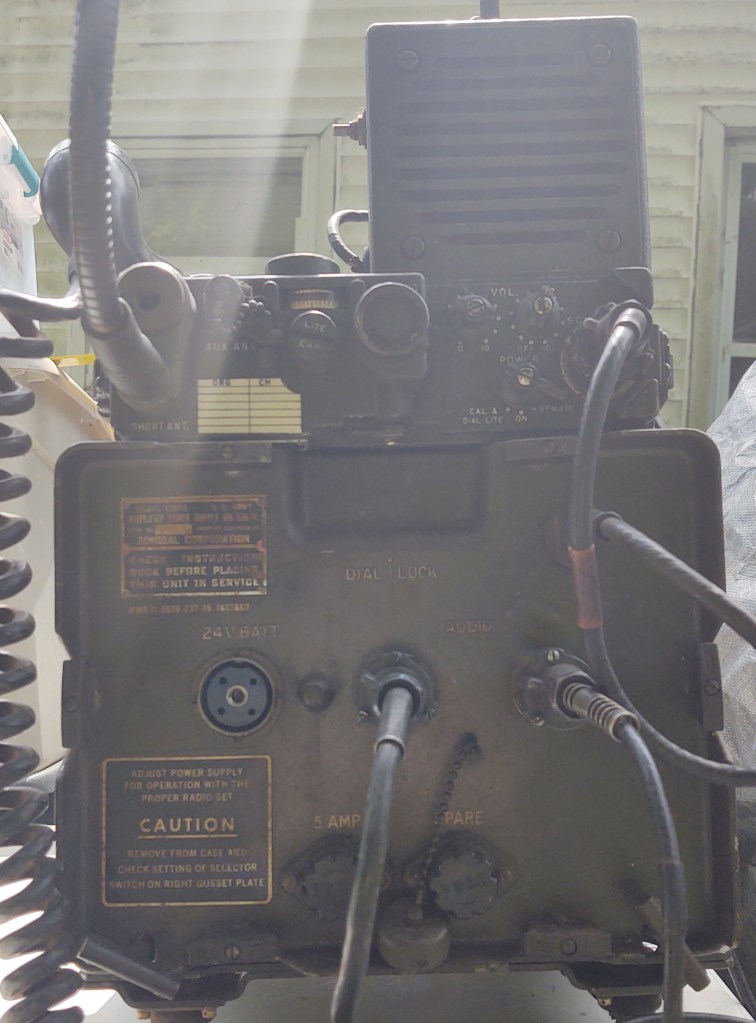
Memorial Day is next weekend, and I’ll be displaying some Cold War communications equipment at the FDR Home and Library in Hyde Park, NY sponsored by my friends and fellow historians with The Duffle Bag & Associates. I’ve done this event since I moved back East, save for when it was cancelled due to COVID.
I previously set up static displays. This year will be different as I’ll have a military shortwave receiver listening to broadcasts, and I’ll be in on the air. I’ll have a Part 15 FM broadcast station, “WFDR,” on 99.5 MHz., and a 6 Meter Amateur Radio station on 51.0 MHz. FM with my PRC-25. Hopefully the band will be open. A couple of my fellow ham operators and historians will be on HF. Callsigns and frequencies will be posted on my Facebook feed.

If you’re within driving distance of FDR come visit. My fellow historians do an excellent job of putting this event together. We’re going to have the Big Band Sound Jazz Orchestra playing on Sunday, and other family events over the course of the weekend.

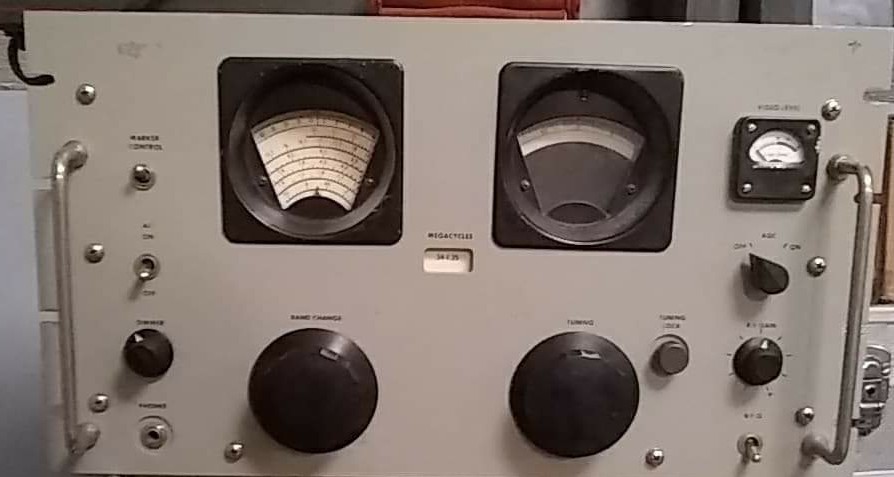
Found this interesting receiver at the most recent Meriden, CT Hamfest last October, and since the price was right hauled it home with me. Why did it catch my eye? For starters, the construction is a dead giveaway that it is a commercial/mil-spec receiver of 1960s or so vintage. Second, the radio had no identifying markings, and no apparent evidence at first glance of being debadged. That is sometimes an identifier of equipment that saw clandestine service in its past life. Third, there was some circuit modules marked as “video converter” which had piqued my curiosity. Finally, if I was a little more awake that morning, I might have recognized the front panel as that of some variant of the Hammarlund SP600 which did see extensive government service. Regardless, it was a mil-spec HF receiver, probably a Black Radio, the price was right, and it was something you normally don’t see at a local hamfest. Once I got home, a Google image search found identical units, and identified it as being an NSA-issue R-1511/GR. Further Google searching discovered that a fellow hobbyist had scanned and uploaded the manual.
From what I discovered online, the R-1511/GR was developed for the National Security Agency in 1968, and was based on the Hammarlund SP600. It saw service until at least the mid 1980s, and based on my research appeared to be part of the AN/GSR-4 Store and Forward Environmental Collection System. With this system, wideband RF spectrum was recorded to magnetic tape for later analysis. While this is an easy task these days for any hobbyist with a PC, free software, and an SDR such as the Lime or HackRF One, the NSA was doing this in the 1960s.
Like a lot of gear at hamfests these days, this receiver was from a silent key’s estate, and its specific history, and that of the silent key, is uncertain. He was possibly in the ASA, NAVSECGRU, or maybe even USAFSS as they would have been the service members familiar with this system. Did this piece of gear listen to the Soviets, the Chinese, or someplace in Central or South America before retiring to civilian life in some former veteran’s ham shack? We’ll never know, but we can safely guess that it was interesting in a “behind the curtain” manner.
The frequency coverage of this radio goes up to the 6 Meter ham band (50-54 MHz.), and the SP600 is still a good performing receiver by today’s standards. This unit, when not being used for displays, is going to be parked on the center of the 6m beacon subband to monitor and record VHF propagation conditions.
Manual:
http://www.nj7p.org/Manuals/PDFs/Military/TEM-0541-01-0A%201-Jun-68%20NJ7P.pdf

Last Month, a few fellow historians and I from the American Veteran’s Historical Museum did a display for the Veterans’ Chow Down held by the PFC Joseph P. Dwyer Vet 2 Vet Program of Putnam County.

Fellow historian Joe S. with his display of uniforms, headgear, and ephemera from the Vietnam War to the present.

Fellow historian Paul M.’s World War II home front and USO display.

My display of Cold War era radio gear.

AN/PRC-25

AN/URC-92

R-1511/GR
James Burrowes OAM
Keeping History Alive - 4th NY Regiment & 4th Battalion Royal Artillery
Honoring the past through excellence in the present.
Kerosene lamp restoration and other curious things.
electronics, open source hardware, hacking and more...
Photoblog of Joshi Daniel
Creating art, poetry, and fiction.
Amateur Radio stories, articles, projects, and more!
Psychological Thrillers of Strategic Justice
Fresh hacks every day
This WordPress.com site is Pacific War era information
The world's oldest and greatest name in pulp
The mindless witterings of an author at work - and play.
International wordsmiths of repute
Better than you expected.
Jake Spurlock as something subtle from the heart of Utah.
write. collaborate. win.
but do you have the courage to start?
Just another WordPress.com site
Jason Scott's Weblog
A site of endless curiosity
because anything is possible with Charisma
Just another WordPress site
Fishing, Hunting and Do It Yourself stuff
Writings of Michael Morgan
Adventures of an Imperfect Man In Search of a Handmade Life
forwards, backwards, sometimes sideways
Learn How To Survive Any Disaster Situation
"God bless it and keep it wild"
Bushcraft, wilderness survival skills and nature
Life's Little Moments
everyday and outdoor gear close to tactical and emergency
Using technology to be prepared
A few of my favorite photos
Warden of Words // Shaper of Stories
Hiking and exploring Nature's finest sculpturings
 Tom's Tech and History Blog