

I always do very well finding stuff here.
I always do very well finding stuff here.

https://www.fdrlibrary.org/events-calendar
Memorial Day Weekend Event:
World War II Military Displays
Time: 10:00 a.m. to 4:00 p.m.
Location: FDR Library Great LawnOn Saturday, May 25 and Sunday, May 26, 2024, in honor of Memorial Day Weekend, the Great Lawn in front of the Franklin D. Roosevelt Presidential Library and Museum will take on the appearance of a World War II encampment with WWII Military Displays.
Period military vehicles of all sizes and soldiers in battle dress will be on hand to share their love of World War II history. Free public event.
The Duffle Bag and Associates, along with the American Veterans Historical Museum and a host of other living historians, are doing Memorial day again at FDR, sponsored by the library. I’ll be there, weather permitting, with a small display.
Normally I do a Cold War display at FDR, despite it being predominantly a World War II themed event. There are a few of us who do a post-1945 displays there. This year however marks the 80th Anniversary of the D-Day landings in Normandy, France, and my wife and younger daughter are planning on cosplaying Rosie the Riveter (their first time going in costume for this event), so I figured it would be a good idea to have a complementary costume. I don’t think, however, that I’ll be doing an ETO impression.
Despite the amount of media play that D-Day receives, there were also other pivotal events that happened elsewhere in June, 1944. Allied forces had captured Rome in the Mediterranean Theater on June 4th. June 5th was the first B-29 bombing mission, Operation Matterhorn, in the CBI theater. June was also the beginning of Operation Forager in the Pacific Theater.
Locally speaking, many National Guard and Reserve units in this area served in the Pacific or CBI Theaters. The 77th Infantry Division (USAR), 43rd Infantry Division (CTARNG et al), 27th Infantry Division (NYARNG), 118th Observation (now Airlift) Squadron (CTANG), and 333rd (now 131st) Fighter Squadron (MAANG) all served in the Pacific or CBI Theaters. Honorable mention goes to the 98th Infantry Division (USAR) that was slated for the cancelled Operation Olympic, and served occupation duty in Japan after the war.
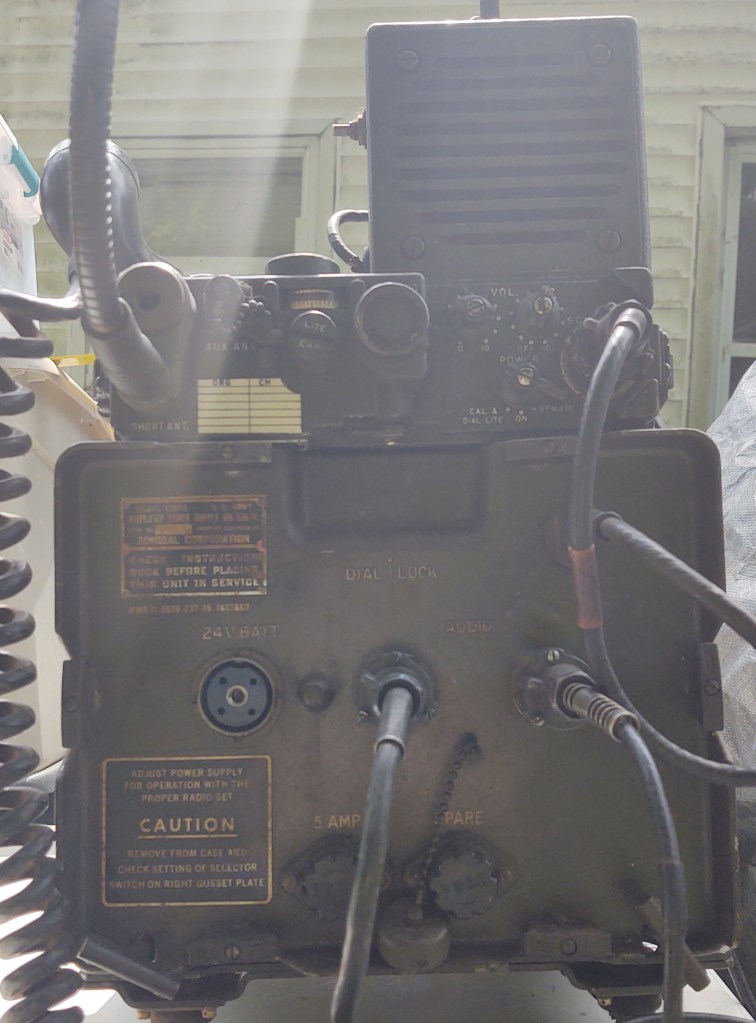
Memorial Day is next weekend, and I’ll be displaying some Cold War communications equipment at the FDR Home and Library in Hyde Park, NY sponsored by my friends and fellow historians with The Duffle Bag & Associates. I’ve done this event since I moved back East, save for when it was cancelled due to COVID.
I previously set up static displays. This year will be different as I’ll have a military shortwave receiver listening to broadcasts, and I’ll be in on the air. I’ll have a Part 15 FM broadcast station, “WFDR,” on 99.5 MHz., and a 6 Meter Amateur Radio station on 51.0 MHz. FM with my PRC-25. Hopefully the band will be open. A couple of my fellow ham operators and historians will be on HF. Callsigns and frequencies will be posted on my Facebook feed.

If you’re within driving distance of FDR come visit. My fellow historians do an excellent job of putting this event together. We’re going to have the Big Band Sound Jazz Orchestra playing on Sunday, and other family events over the course of the weekend.

I missed the past two years for Memorial Day at FDR because of COVID. Things settled down enough this year that the National Archives and the National Park Service opened it up for my associates and I this year. This time around I planned for an even bigger display than in 2019.


A line of rain and thunderstorms came through Saturday, making that day a wash (no pun intended) for the most part. Sunday was much better. I didn’t make it Saturday because of the weather, but got there early Sunday morning and set my display up.
This year I displayed three tables of radio communications and electronics test equipment covering a time span from World War II to the Cold War eras. I also set up a Part 15 FM radio station, “WFDR,” on 99.5 MHz. that played some 1940s era music for a short while.

In this picture there is a Cold War era Soviet R-105m VHF transceiver, a PRC-25, PRC-75, PRC-74, WW2 Navy/Marine Corps TBY, WW2 R-156 sonobouy receiver, and WW2 BC-1000/SCR-300.

This picture shows an early WW2 Amateur Radio station consisting of a Hallicrafters SX-25 (which did see military use during WW2) and a Utah Junior HF CW transmitter, along with a reproduction foxhole radio using an old “blue blade” safety razor blade. Unfortunately I didn’t have the space to set up a decent antenna to run the foxhole radio. Two of next years’s goals include getting reception for the foxhole radio and getting a vintage Amateur Radio station on the air.

The bottom right shows a small collection of electronic test equipment. We have a radar IFF test set, oscilliscope, VOM meter, and RF SWR/power meter.


Many history buffs find themselves collecting artifacts related to their particular interest. I’ve been collecting military memorabilia, in particular insignia, for the past 43 years. My friend Brian from the Duffle Bag was the one who got me started on this hobby. He pointed out a few advantages to collecting insignia:
The two biggest appeals of insignia collecting for me are aesthetics and history. Some of the designs are very attractive, and they all tell a story of the unit’s origin and history. When I get a new addition to the collection, once I identify it I try to find out where the unit was stationed , what they did, and what campaigns they were in. So for the collector, the acquisition of a new piece also usually involves doing research.
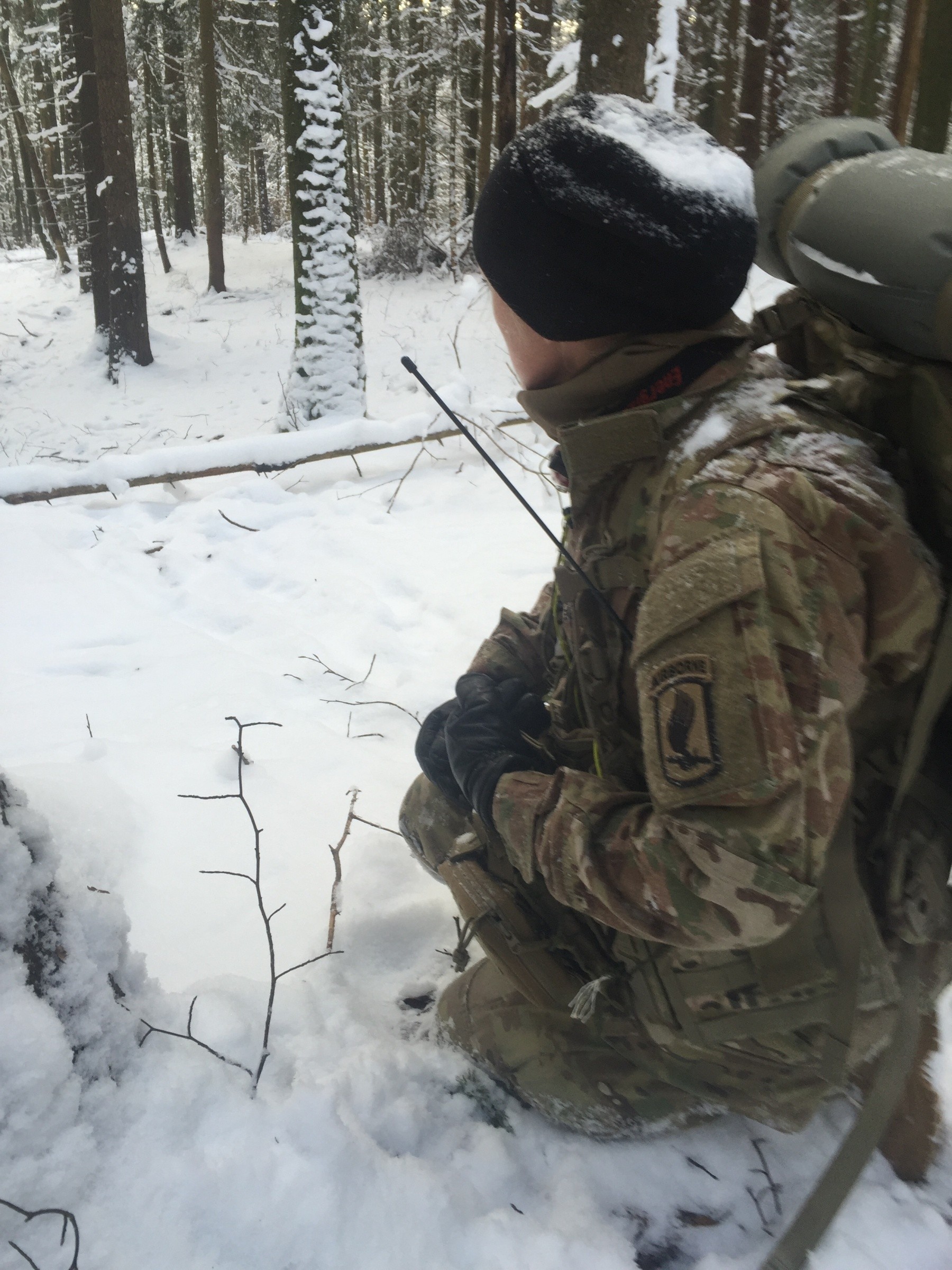
One of the types of insignia I started with is US Army shoulder sleeve insignia (SSI). SSI are worn on the sleeves of the US Army uniform to show a GI’s current (left sleeve) and former wartime (right sleeve) unit assignments. Shown to the left is a US Army GI wearing the SSI of the 173th Airborne Brigade, aka “Sky Soldiers.” (U.S. Army photo) The SSI pictured, by the way, is also an example of a subdued insignia worn on the combat uniform. The dress uniform will have a full-color version.

Here is an example of the same SSI in full color on a dress uniform. In this instance the SSI is on the right sleeve showing prior wartime service in the 173th ABN BDE. This picture is of Army Medic SP6 Lawrence Joel receiving The Medal Of Honor from President Lyndon Johnson on March 9, 1967 (US Army photo).
How many different SSI are out there for you to collect? Here are some examples:


These are assortments of World War II and Cold War era US Army SSI for sale at the Duffle Bag, and represent a very small example of what’s available. How much? The World War II SSI range from $5 to $20+ each depending on desirability and rarity of a particular patch. The Cold War era stuff are $2-$5 each for the most part, sometimes you can even find them for less than a buck.
To be continued…

Twice a year (under normal circumstances), my friends Brian and Jean, who own my favorite Army/Navy store, host a militaria show down in Patterson, NY. It’s real easy to get there. You can take the MTA Metro-North Harlem Line to Patterson and walk the quarter mile down to the Rec Center. You can also take I-84 to Rt. 311 into Patterson, getting off at what once was Exit 18 and is now Exit 61, or take Rt. 22 to Rt. 311 into Patterson Village proper. At any rate, the What3Words for the entrance to the Rec Center are ///muddle.indefinite.encroach. They haven’t had a show since COVID started, so it’s been almost two years. Everyone is champing at the bit, and it’s going to be a good show.
James Burrowes OAM
Keeping History Alive - 4th NY Regiment & 4th Battalion Royal Artillery
Honoring the past through excellence in the present.
Kerosene lamp restoration and other curious things.
electronics, open source hardware, hacking and more...
Photoblog of Joshi Daniel
Creating art, poetry, and fiction.
Amateur Radio stories, articles, projects, and more!
Psychological Thrillers of Strategic Justice
Fresh hacks every day
This WordPress.com site is Pacific War era information
The world's oldest and greatest name in pulp
The mindless witterings of an author at work - and play.
International wordsmiths of repute
Better than you expected.
Jake Spurlock as something subtle from the heart of Utah.
write. collaborate. win.
but do you have the courage to start?
Just another WordPress.com site
Jason Scott's Weblog
A site of endless curiosity
because anything is possible with Charisma
Just another WordPress site
Fishing, Hunting and Do It Yourself stuff
Writings of Michael Morgan
Adventures of an Imperfect Man In Search of a Handmade Life
forwards, backwards, sometimes sideways
Learn How To Survive Any Disaster Situation
"God bless it and keep it wild"
Bushcraft, wilderness survival skills and nature
Life's Little Moments
everyday and outdoor gear close to tactical and emergency
Using technology to be prepared
A few of my favorite photos
Warden of Words // Shaper of Stories
Hiking and exploring Nature's finest sculpturings
 Tom's Tech and History Blog