Posted in Uncategorized

Military Collectors Club Show Tomorrow

I’m sad to say that my friends at The Duffle Bag have decided to close down the retail store front at the end of the month for the time being, and go exclusively with online and show sales. They also however decided to expand to monthly shows based around a military collectors club, similar to the Bay State Militaria Collectors.

I’ll give a short presentation at the show tomorrow on military radio receivers for living history displays. For more information see https://www.facebook.com/thedufflebag.

Posted in amateur radio, living history, military history, New York, Radio Communications, Shortwave, Signal Corps, U.S. Navy, Uncategorized, us army, World War II

News Release: FDR Home & Library Memorial Day Weekend Events Announced

https://archives-20973928.hs-sites.com/news-release-fdr-home-library-memorial-day-weekend-events-announced

PRC-10

Memorial Day is next weekend, and I’ll be displaying some Cold War communications equipment at the FDR Home and Library in Hyde Park, NY sponsored by my friends and fellow historians with The Duffle Bag & Associates. I’ve done this event since I moved back East, save for when it was cancelled due to COVID.

I previously set up static displays. This year will be different as I’ll have a military shortwave receiver listening to broadcasts, and I’ll be in on the air. I’ll have a Part 15 FM broadcast station, “WFDR,” on 99.5 MHz., and a 6 Meter Amateur Radio station on 51.0 MHz. FM with my PRC-25. Hopefully the band will be open. A couple of my fellow ham operators and historians will be on HF. Callsigns and frequencies will be posted on my Facebook feed.

If you’re within driving distance of FDR come visit. My fellow historians do an excellent job of putting this event together. We’re going to have the Big Band Sound Jazz Orchestra playing on Sunday, and other family events over the course of the weekend.

Posted in living history, military history, New York, Signal Corps, U.S. Navy, Uncategorized, us army, World War II

Memorial Day 2022

I missed the past two years for Memorial Day at FDR because of COVID. Things settled down enough this year that the National Archives and the National Park Service opened it up for my associates and I this year. This time around I planned for an even bigger display than in 2019.

A line of rain and thunderstorms came through Saturday, making that day a wash (no pun intended) for the most part. Sunday was much better. I didn’t make it Saturday because of the weather, but got there early Sunday morning and set my display up.

This year I displayed three tables of radio communications and electronics test equipment covering a time span from World War II to the Cold War eras. I also set up a Part 15 FM radio station, “WFDR,” on 99.5 MHz. that played some 1940s era music for a short while.

In this picture there is a Cold War era Soviet R-105m VHF transceiver, a PRC-25, PRC-75, PRC-74, WW2 Navy/Marine Corps TBY, WW2 R-156 sonobouy receiver, and WW2 BC-1000/SCR-300.

This picture shows an early WW2 Amateur Radio station consisting of a Hallicrafters SX-25 (which did see military use during WW2) and a Utah Junior HF CW transmitter, along with a reproduction foxhole radio using an old “blue blade” safety razor blade. Unfortunately I didn’t have the space to set up a decent antenna to run the foxhole radio. Two of next years’s goals include getting reception for the foxhole radio and getting a vintage Amateur Radio station on the air.

The bottom right shows a small collection of electronic test equipment. We have a radar IFF test set, oscilliscope, VOM meter, and RF SWR/power meter.

Posted in Uncategorized

Two weekends ago was the local radio and communications museum’s swap meet. This is one of my regular events because I’m a member of the museum, and it’s only a 30 minute drive away on a Saturday morning. More often than not I’m also tailgating, which I did this past time. It was a good meet, although I did more trading than selling. Still though, I came home with less stuff than I arrived with, and a little more cash. The major acquisitions were a couple of WW2 aircraft command set radios which I have been getting into as of late, a 150 MHz. Tektronix 454 oscilloscope, and a WW2 vintage ABA-1 IFF transmitter/receiver which I discovered will go down into the 70cm ham band for AM and CW operation. The best part of the swap comes at the end of the day when the museum gives away whatever is left on their tables before dumpstering it. Going through the various boxes there were a few transformers and junk radio chassis that I gutted for some nice variable capacitors, and inductors. Not a bad haul.

Managed to get the workshop/lab a little more cleaned up and organized over the weekend. Put a little HF and VHF (6m and 2m) ham station on a table in the corner, but still need to put up antennas. I’ll be doing mostly CW on the old HF Novice sub-bands, and weak-signal on VHF. There are also a couple 2 meter FM simplex frequencies that see local use in addition to 146.52 MHz.

The Novice class ham license is a thing of the past with Technician being the new entry-level license for Amateur Radio. The Tech ticket is mostly VHF+ which in reality means the VHF/UHF bands at 1.2 GHz. and below. There is no off-the-shelf gear above 1.2 GHz., and I don’t think the average newly-minted Tech is going to homebrew any microwave weak signal gear despite being allowed to operate up there. Tech class ticket holders however do have some HF privileges. They can run sideband on 10 Meters between 28.300-28.500 MHz, and they can run CW on small portions of 80, 40, 15, and 10 Meters. Back in the analog TV days, a lot of hams would scrounge the 3.579 MHz. colorburst crystal out of an old TV set and set up on 80 Meters. There are still a few hams that do this today, the informal CW OP group called the Color Burst Liberation Army (CBLA).

Posted in Uncategorized

Revised Short Story – B.A.S.I.C.

B.A.S.I.C.
by Tom Filecco
tf@sdf.org
Copyright 2022
Creative Commons License
This work is licensed under a Creative Commons Attribution-NonCommercial-ShareAlike 4.0 International License.

READY
_

The cursor stayed there, blinking on the screen. It did not display a request for a username/password. There was no display of tiny graphic icons arranged in neat rows. It was just a blinking underline below a single word, telling him the machine was good to go. Johnny stared at it for a little while, and thought “So this is how it all begins…” He had found the box on the shelf in a dusty antique/junk shop in a twentieth century vintage strip mall that had seen better days. It was a black and silver wedge-shaped keyboard, a black rectangular power supply, and a couple of books. The price was right. The shop owner was happy to finally be rid of it. Johnny asked if there was anything else for it. The shop owner disappeared in the back, and came out with a couple of smaller peripherals, cables with strange connectors at either end, some flat black plastic flexible squares, and a few more books. It was all covered with enough dust to show that the entire lot had not been touched by human hands in some time. Johnny took it all, bungee-corded it to his bicycle rack, and covered it with a surplus army poncho. As he rode home, he felt rather fortunate that there was a place within bike-riding distance where he could find neat stuff cheap. Little did he know he was about to embark on a small adventure.

Johnny rode home. He unpacked everything, and cleaned off the dust. The instructions in the manual were clear enough. They mentioned something about a “TV modulator”. Johnny goes into the basement, and finds it. The old TV set is a big, heavy, glass and plastic thing labeled “RCA XL100.” It belonged to his grandparents. He hopes it still works. Johnny hooks up all the cables, plugs everything into a wall outlet, and turns on the switch. It all works just fine. He is rewarded with a single word, and a blinking underline.
READY
_

Johnny wondered if this was how it all began, back in the early heady days of computer hacking. He uses computing devices in school. They are safely locked down, “secure” against the threat of cyber-terror. They even worked more often than not. What, however, if you wanted to take a peek at the man behind the curtain? That was forbidden. A schoolmate of his once showed him this thing called “Linux” before said schoolmate’s parents confiscated it. “Open Source” meant it was wide open for terrorists and pedophiles to get into, and the online consumption experience needed to be safe for the children. There he was, cursor blinking at him, and despite the fact that this old computer was over twice his age, he realized the enormity that it all was waiting for his command, and that no one or nothing was standing between him and the capability to create whatever at will. The whole magilla hit him like a ton of bricks delivered with the force of a freight train, and it was all he could do to stand up, walk away from the thing, and go ponder over it all with a walk in the woods.

The woods were former, now grown in, farmland on the back end of his family’s property. He wandered the woods for the greater part of an afternoon, eventually coming to one of his favorite places, the one he called “Engine Rock.” It was a giant boulder, a remnant of the glaciers. It was about six feet high, with a flat top where one could climb up and sit. A small metal scrap pile laid nearby from when there was once a farm here. Its most prominent feature was a rusty old engine block from a truck or maybe a tractor. He climbed up onto the boulder, taking in the clear blue sky and the scent of the trees. High overhead, a jet plane laid a white contrail over the wild blue yonder, persisting for a few minutes before being dispersed by the wind currents. Johnny had a moment of Zen, contemplating the experience he just had. He asked the Universe for, well, something. A sign. He climbs down off the boulder, and spots something next to the engine block. It is a shiny, square, angular, metallic-looking rock. He recognizes it as a piece of Galena. He remembers something his grandfather showed him. A “crystal radio” it was called. You made it with a piece of Galena, and an oatmeal box with wire wrapped around it. He still has the headphones from when he last built one with his grandfather. They had to be “high impedance” or something like that. He pockets the Galena and heads home.

He walks inside, and remembers how his family and him finished a box of oatmeal this morning. The empty box is still in the recycling bin. He recovers the discarded box, and goes to the garage. He finds a spool of bell wire, some scrap wood, and a half-inch copper pipe cap. He is ready to proceed. Johnny wraps 100 turns of bell wire around the box, scraping the insulation off the wire in a line where the top of the coil will be. He screws the pipe cap into the block of wood, and wedges the Galena into the pipe cap with some Aluminum foil. The coil is wired across his Galena detector. Johnny finds some more wire, and strings it from his bedroom window to a nearby tree. Next comes the ground. He thinks the baseboard heater in his bedroom should work. He remembers that crystal radios work best at night. Johnny decides he will wait until after dinner. He hopes he remembered how to put it all together correctly.

Dinner is filled with conversation as usual, but Johnny remains mostly quiet this evening. He is thinking about his new computer, and how his dad might react. Johnny and his sister both have Chromebooks they use for school, but those are more tools than toys. His parents have a computer they use for the family business, but Johnny stays off of it. Johnny knows his dad used to work with computers, but doesn’t talk about it. Johnny has always had the feeling that his dad’s old job was a forbidden topic for some reason, and doesn’t ask.

Johnny’s parents are both hardcore NPR listeners, and a part of dinnertime discussion involves what they heard on the news. The parents of Johnny’s friend who had the Linux CD confiscated would have called them “a bunch of fucking flaming liberals.” The rest of their discussion is about how their day went. Johnny normally has a lot to say, he’s usually a busy kid, His parents sense his unusual reticence this evening, but don’t comment. After a sausage and broccoli penne that would rival any restaurant in Little Italy and equally good cheesecake desert, Johnny excuses himself. It’s time for him to consult the aether.

It is dark now. He connects his headphones across the Galena detector. Moves the tuning wiper across the coil. A station comes in loud and clear. It sounds like a debate on a talk radio program. There is an author named Corey Doctrow talking about the “war on general purpose computing,” how people don’t truly own things they can’t take apart and fix, and why this is bad for society and civil liberties in general. Jimmy writes down the author’s name. The opposing voice and show host accuse him of being a supporter of terrorists and child molesters. The boy has has heard enough. He removes the headphones from his ears, his decision made. He sits back down at the old computer. “Where do I start?” he asks himself. One of the books is titled BASIC Programming. He opens it, turns to the first page, “Beginners All-purpose Symbolic Instruction Code.” He starts to read. The book gives him a programming example to try on the computer. He types it in.
10 PRINT “HELLO WORLD.”
20 END

Johnny finishes his first ever computer program, and types “RUN.” He is rewarded with “HELLO WORLD.” displayed on the screen. He reads a little more and adds another line.
15 GOTO 10

Now “HELLO WORLD.” is printed over and over again on the screen in what Johnny later finds out is known as an “idiot loop.” Wanting the feelings of accomplishment of elation to last, he keeps on hacking. It was a Saturday night, and Johnny didn’t have anything to do early on Sunday morning. He had Googled Corey Doctrow, BASIC computer programming language, and the model of his computer. Johnny had bought, for an incredible bargain he discovered, a Texas Instruments TI-99/4A. The machine was powerful for its day, but something of an outlier and not as popular as other machines of the era. Nevertheless, he was having a blast playing around with the old piece of computing iron. He had put his crystal set’s headphones back on. He tuned around a bit, and found this crazy talk show called Coast To Coast AM where the host was talking about UFOs and other high weirdness. Johnny thought it was the perfect accompaniment to his newly-found love of what he learned was called “retro computing.” The reception wasn’t perfect. Whenever he ran a program on the TI-99/4A is would make noises on the crystal set, but he could still hear the show.

John Senior, Johnny’s dad, had just sat down for his evening indulgence. When everything is shut down and settled in for the night, he grabs a cup of decaf coffee in his old chipped and stained AT&T coffee mug he has had since graduating college, sits in his favorite Boston Rocker, and listens to Coast to Coast AM. John became hooked on the show decades ago when he was a young software developer right out of college working late at night to make sure a project was completed on time. Over the years he became disillusioned with the industry, despite the fact that it paid well. He put in his time, and retired early enough in life to be able to do something else. Now he has a wood working shop, a thriving business making heirloom grade furniture, and the ability to work on his own schedule and listen to his favorite show at night. It’s Saturday night, and nothing is going on the next day.

The one thing about coffee, decaf or otherwise, is that you can only borrow it. Sure enough, after a while John has to go return his evening beverage. Walking up the stairs to the bathroom, he goes past his son’s bedroom. It’s summer time and a Saturday night to boot, so the kids don’t have a bed time. What catches his ear is the distinct staccato clicks of what can only be an old-school keyboard coming from his son’s room. He pauses. “Yep.” He thinks to himself. “That’s an old-school keyboard.” He knocks on the door. No response. He knocks again. Still no response. The keyboard clicks continue. John quietly chuckles to himself. “Sounds like me back when I cranking out code for a living.” John opens the door, and sees why his son didn’t hear him. Johnny’s back is to the door, and he’s wearing headphones. He’s sitting on front of the old TV in the basement, typing on a keyboard. John recognizes BASIC code on the screen, and knows a hacking session when he sees one. He sure enough participated in plenty of them. Johnny’s Chromebook is open to a website, “99er.net.” The ceiling light in Johnny’s bedroom is off. John flicks it on and off quickly to get his son’s attention.

Johnny was deep into messing with the TI’s graphics capability and trying to figure out some basic collision detection. The guest on Coast To Coast AM was talking about space aliens on Long Island in New York, and while to Johnny it sounded like a load of bullshit it was still entertaining listening. The station he was picking up was about 200 miles away which only added to the atmosphere. He was so into it, that he nearly jumped out of his skin when he saw the lights flicker. He turned around, and there was his dad. Nervousness gripped him. His dad caught him with the computer. He takes his headphones off, and starts stuttering. “Dad, I uh-uh-uh.” His dad walks over to the computer, a look of amazement on his face. “Where did you get this?!” his asks in a tone of incredulity and surprise. Johnny replies, “I got it at the junk shop.” His dad laughs. “No shit? Heh heh. How much did you pay for it?” Johnny pauses for a moment. He’s not sure where this conversation is going. He decides that it’s probably best to be totally truthful in this instance. “I paid Twenty Dollars for it.” His dad laughs again. “That’s all? They cost a lot more back when my parents bought me one.” John pauses for a second. “That’s a Texas Instruments TI-99/4A, and it was my first computer in Middle School. I think my parents sold it at a yard sale when I went off to college. Why didn’t you tell me you bought an old computer?” A wave of relief washed over Johnny as he replied. “I know you used to work with computers, and quit. I thought you didn’t like them.” John laughed. “I was a computer programmer for 25 years, and retired when it stopped being fun. It wasn’t the computers I hated, it was the way the computer business turned out.” Not wanting to sour his kid away from hacking, John changes the subject. “I see you got grandpa’s old ham radio headphones, and you built a crystal set. What were you listening to?” John asks. “It’s this crazy show about UFOs and stuff called…” John and his son both say “Coast to Coast AM” at the same time. John gets thoughtful for a moment. “Hang on a second son.” John goes back downstairs and brings up his little portable radio. He turns it on to George interviewing some time traveler about Montauk Point. “So, tell me what you’re working on.” John gestures to the screen. Johnny replies, “I’m trying to get collision detection working.” John glances at the code. “You need to add an extra subroutine after that IF THEN line…”

John was a little rusty not having messed with TI personal computer graphics since the 1980s, but it all started coming back to him. He looked at the clock, realized it was 2:30 in the morning, and that the both of them should probably catch some sleep. They both woke up a little later than usual the next day. John’s wife was wondering why he came to bed so late the night before. He explained what happened during their morning coffee ritual. His wife snorted trying not to laugh out loud. “He’s a computer hacker just like his father was.” John just nodded and said “I guess it runs in the family.” Johnny came down all bleary eyed a little later. They all sat down for breakfast. Johnny’s mother opened the conversation. “Your father said the two of you had a late night hacking session. What did you learn?” Johnny gushed, “I found out we both have the same favorite radio show! And dad taught me how to program computer games!” Johnny’s sister rolled her eyes at her brother’s and dad’s geek-ness. She wanted to become a veterinarian like her mother.

After breakfast was finished, John asked his son to go out to the workshop with him. It was an old red wooden barn that he converted into a woodworking shop. John goes into a corner, pulls an old cardboard box out from under a bench, and starts removing items from it. He pulls out a beige keyboard, monitor, and CPU unit. The CPU unit has the old AT&T “Deathstar” logo on it, and is marked “3B1.” About five minutes later the system is assembled, pluged in, and booting up. John looks at his son and gestures to the machine while saying “BASIC on those old microcomputers is fun, but limited. Let me tell you about Unix.”

Posted in Uncategorized

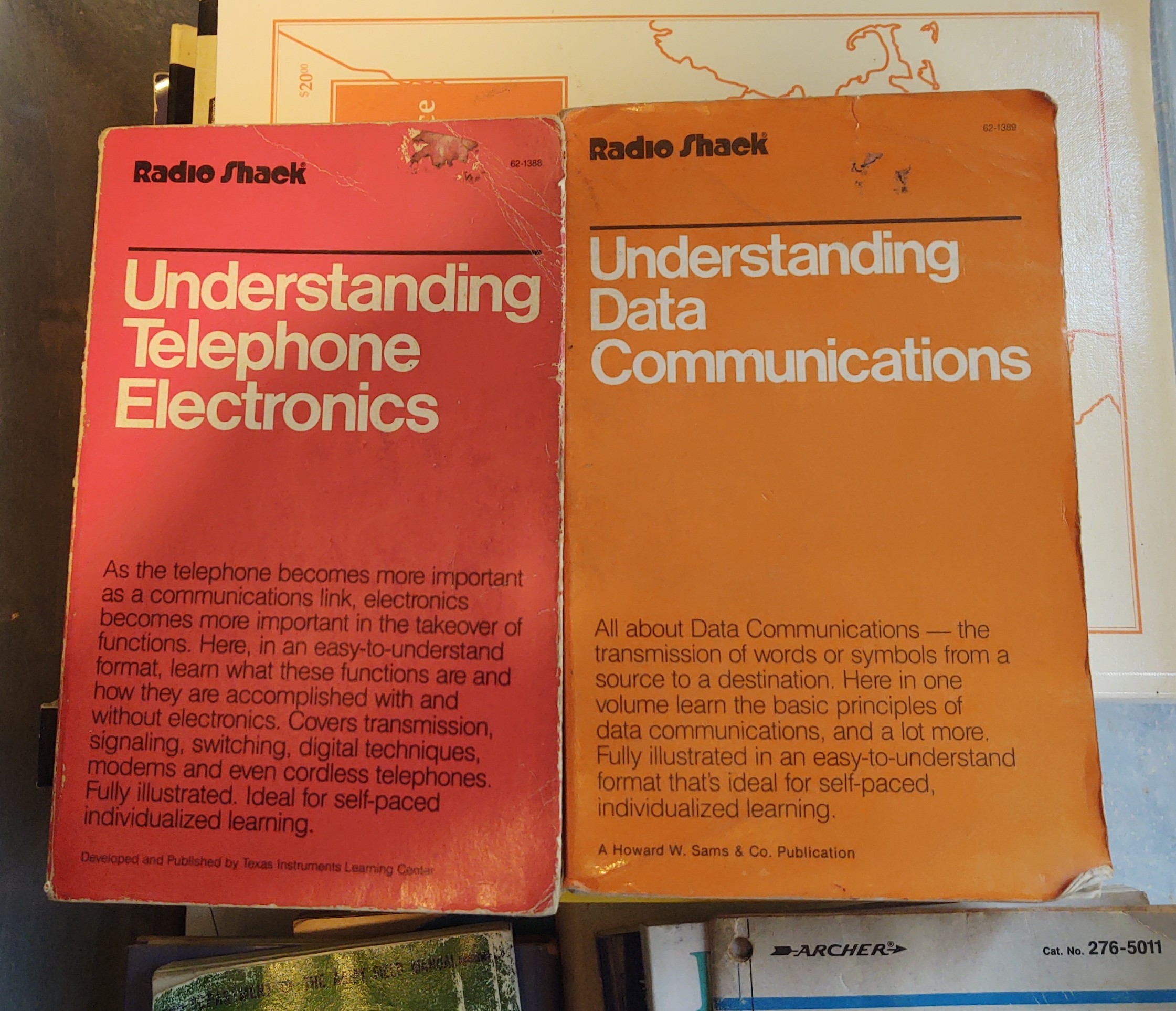
When I started hacking in 1983, it was with a Timex Sinclair 1000 and one of the electronics projects kits from Radio Shack. My first books were Getting Started In Electronics by Forrest Mims, a copy of Basic BASIC by James S. Coan that was already five years old when I started learning how to program, and a couple books from the TI/Sams Understanding series that you could buy at Radio Shack.

The hobby has changed since then. Radio Shack is no longer the massive electronic hobbyist store chain it was back in the 1980s, and BASIC has been supplanted by other beginner languages. Online ordering can have pretty much anything sent to your door, and it’s less expensive. My 1983 $100 2K Z80 computer is now a 2022 $100 Raspberry Pi4 that’s a lot more capable. Python now seems to be the beginner’s language of choice, and I found it to be as easy to learn as BASIC. Getting Started In Electronics is still in print. Velleman and Elenco still make the same style of project kits/labs that you could buy at Radio Shack.

The Electronics Playground kits are old-school. For those of you with a more modern digital bent there are vendors that will sell you a Raspberry Pi package that includes a prototyping breadboard and components. At some time you’ll find yourself wanting both.

Posted in Uncategorized

Wherever You Go, There You Are

Wherever You Go, There You Are
by Mr. Icom

This article originally appeared in the AUTUMN 2021 issue of 2600: The Hacker Quarterly.

It was the early 1980s when you started seeing personal “microcomputers” in Radio Shack and in department stores such as Sears, Caldor, and Service Merchandise. The stores fiendishly placed demonstrator models in their consumer electronics departments so unsuspecting children, such as the author, could get hooked on the digital gateway drug known as Beginners All-Purpose Symbolic Instruction Code (BASIC). You start typing, and if you are of a certain ilk, the whole magilla hits you like a ton of bricks and you realize that you have the power to do almost anything with sequences of ones and zeros, and all you have to do is learn the language. It was 1982 when I received my first computer, and I got my first modem in late 1983. I quickly found Private Sector BBS, and from there learned about 2600 Magazine. I had already become familiar with the terms “hacker” and “hacking” from reading Steve Levy’s book, and from there realized two things. One did not need a computer or modem to hack, and that there was an actual word for what I had been doing ever since conscious memory. Getting notions, asking questions like “What is this?” and “How does this work?,” doing research, exploring, and experimenting. You get the idea.

One of my first, and probably least successful at the time, notions was noticing a rail line, now known as the “Old Put” that ended at the lumber store where my parents used to shop, and deciding it would be a neat thing to explore. This was in the 1970s and I was about 4 or 5 at the time. This was about 10 years before I learned from reading Steve Levy’s book that the original hackers at MIT in the 1960s started with model railroads, and used surplus telephone equipment to do switching. A book I have on the “Old Put” showed it was abandoned a few years before I discovered it, and later I remember the railroad pulling the tracks up. The old right of way remained mostly intact for a number of years, and I explored it thoroughly looking for something I still can’t quite put words to. These days it’s a rail trail and much more accessible than it was in the 1980s. What’s interesting about these former rail lines is that telecommunications infrastructure was and in many cases still is often run underground along the same right of way. One active rail line in my area has still has standing utility poles marked “WUT” (Western Union Telegraph). Another former right of way turned rail trail has AT&T underground cable signs every few hundred yards or so. The underground cable markings all have fairly recent dates on them, and they are often near manholes.

My next notion involved the phone system. Keep in mind this was still during the late 1970s and early 1980s when one had to pay for any calls outside those of your local area. Running up the parents’ phone bill was an ill-advised course of action, as was doing anything on a line traceable to you, but around town were these public phones that recently started providing you with a dial-tone without having to put a dime in first. You still had to pay for most calls, except for 800 numbers. It was right around this time that personal microcomputers began showing up at places where mundane parents would normally shop, and I discovered them along with modems. Then one day my friend Jim, who moved to a neighboring school district a few years earlier, introduced me to his friend Jason who was a hacker and told me about the late TAP magazine and this new one called 2600.

Playing around in BASIC and early 8-bit assembly language was fun, but for me, hacking was more about networks, the lines of communications and travel that connect everything together. Computers and modems were simply tools to learn about the network, and I discovered that learning about networks whatever they may be, was and still is more about the journey than it is the destination. The destinations can be cool (and often are), but the fun was in getting there. You can start this journey without leaving home, because where you live is at the terminus of least one network you can explore, and may be along the lines of communications of a few others. As a bonus, most of your initial exploratory efforts can be passive and/or legal. The former is good because passive exploration generates no signature for the most part. The latter is good because you don’t want to get your ass in a sling and have to hire a lawyer to get you undone.

Go outside for a minute, and take a look at the utility pole in front of your home. It should look something like what you see in the picture. The two sets of wires labeled 1A and 1B are electric. Number 1A is the primary at 10,000+ volts in the US. From there it goes through a transformer which is the can below the primary wires to a nominal 240/120 volt feed to your house, labeled 1B. Don’t fuck with those, because they will kill you in a painful and demonstrative manner. Number 2 is the feed from the Cable TV (CATV) company. It probably looks silver in color. That’s a radio frequency feed, and probably the most interesting of the lot due to the bandwidth that’s coming down to your house if you have the service. It potentially has both broadcast audio/video and internet service on it. Number 3 is belongs to the phone company. It’s probably black in color. In most places it’s a bundle copper wire pairs, or maybe a fiber optic line. It used to be that you could get a dialtone off it, but it’s just as likely to be a digital VDSL signal instead, with the dialtone provided by your VDSL modem instead of Telco switching equipment at the CO or RT.

Now look on your roof. Back in the days before CATV was ubiquitous, people put antennas on the roofs of their homes to receive broadcast TV signals. This is now called “Over The Air” (OTA) TV, and is still a thing among some people because it is free. Last time I looked at OTA signals I was in Central Wyoming, one of the most remote places in the continental USA, and still managed to find 15 OTA channels with little more than a hunk of coat-hanger wire stuck above the roof line of a ranch house, maybe 10-15 feet off the ground. If you have an antenna on the roof, there is still probably some feedline going down into your home somewhere, and there still might be a working directional rotor system that lets you aim the antenna in different directions. Note this for later because that TV antenna probably has a frequency coverage range of about 50-900 MHz. and may useful in future explorations.

What I’ve just pointed out to you are a few avenues of exploration that don’t require you to do anything but observe and pay attention to what you discover, and take notes. This passive observation is undetectable, and for the most part totally legal. Finally, it shows you first-hand how things work in the real world. Let’s start at the bottom, and take a look at the phone line coming in your house. If your dialtone is provided by the black box hooked up to a VDSL or FiOS line, then there probably isn’t much you can do. If, however, you still have a POTS local loop going to a SLC or RT down the road, or perhaps all the way to the CO, there is an opportunity to hear all sorts of interesting things while your phone is on-hook. The condition of your cable pair might be poor enough that you can hear crosstalk. You might hear a technician borrowing your line to make a phone call. You will also be able to hear any testing going on with your phone line, and anyone who decides to “beige box” off your pair.

The easiest and safest (for your equipment) way to do this is to build a telephone recording interface as shown here. This schematic will allow low-level AC (audio) to pass through to the recording device, while blocking the nominal 48V and 90V line and ring voltages. A low enough DC resistance on the line will cause it to go off-hook, and the ring voltage might damage any experimental equipment you have connected to the line. For under $50 you can buy a voice-activated digital recorder that’ll give you over 60 hours of recording time, or you can feed it into your soundcard input for recording to your PC. Software and stand-alone electronic devices exist that will allow you to decode DTMF tones. Recording your telecom experimentation (provided you’re not otherwise breaking the law) and monitoring your line for service trouble is generally legal within certain guidelines that vary state to state. Decoding the DTMF data that’s being sent on a phone line your pay for is also legal. Recording someone else’s phone conversations is generally not legal.

Going further up the pole, the CATV feed gets more interesting. That coaxial cable feed coming into your residence contains RF signals from 7 MHz. – 1 GHz. The frequency range from 54 MHz. – 1 GHz. Is the downstream side going from the head-end to your residence, and 7-50 MHz. is the upstream side for signals going back to the head-end. Depending on the CATV system, the signals on the feed may be analog, digital, or a combination of both. Also, depending on the level of CATV service your residence subscribes to, there may be filters on the CATV feed to block certain frequency ranges used by services/channels that are not in your subscription. If you don’t have any service, the CATV provider may have installed a filter that blocks all RF from coming down your coax feed. Depending on the weather or how busy the tech was that particular day, a filter may not have been installed after service was discontinued. Filters such as these were mostly a thing back in the days of analog television when you could just hook a TV up to your CATV feed and get a nominal level of service. CATV service providers who are up to date are all digital and fully encrypted. They rely on the encryption to prevent theft of service. In this case your mileage may vary, and the only way to find out is to plug into the system and give it a look.

I purchased a Wavetek SAM (Signal Analysis Meter) at a hamfest (amateur radio swap meet) a few years ago for $20. This receiver was used by TV technicians to check the signal strength at a customer’s residence when installing a feed and troubleshoot system problems. My SAM has a frequency range of 0-300 MHz., but some go up to 890 MHz. for UHF over-the-air television. When TV went digital, the older analog SAMs started getting sold for pennies on the dollar. These days, the Older SAM units are popular with FM broadcast band radio enthusiasts. I hooked mine up to a disconnected Comcast CATV feed to discover what I could hear. The only things I heard were a couple local AM broadcast band stations, and the digital buzz of the TV channel signals. The latter was to be expected, and I’m guessing the former was due to the length of the coaxial cable feed from the pole acting as an antenna. A TV receiver was then attached to the system, and not surprisingly I discovered that the system was 100% encrypted. Regardless of the outcome, you don’t know what you might find on a communications cable feed unless you explore and go look. I’m an old-school analog hardware hacker type, and prefer gear like the Wavetek SAM that I can easily take apart, work on, and modify if I so desire. Getting that kind of gear involves visiting places like hamfests and surplus stores looking for older gear cheap. If this is not for you right now, you can duplicate the previous exercise with an RTL-SDR. You will likely need an RF adapter to connect the male F-connector on your CATV coax to whatever your RTL-SDR is using, probably either a SMA or BNC female.

So far you’ve looked at the terminus of two different communications networks that feed into your home. Depending on the age of your telecom and CATV infrastructures, you might have discovered some interesting things or nothing at all. Whatever you found, you were still limited by the bandwidth of the media and the equipment on the other end. Now you get to expand your each into the aether. Earlier in this article, I asked you to look on the roof of your residence to see if an OTA TV antenna was still there from the days before CATV. You should check even if you live in an apartment building complex. When I moved out of my parents house in the mid 1990s, my first apartment had a TV antenna feed despite also being wired for CATV. Twenty-five years later I checked Google street view, and there is still an antenna on the roof of the building. If you have a modern (digital) TV, plug it into the cable coming down from the antenna, and do a channel scan. See what OTA channels you can receive, and research the location of the stations’ transmitter sites on the FCC web page. If the antenna and cabling to it is still serviceable, you should be able to pick up something. OTA TV might be interesting for a little while if you can get PBS or an independent station that’s not affiliated with the big-4 (ABC, NBC, CBS, and Fox), but if the OTA feed is working you should connect an RTL-SDR to it and see what else is out there. If the antenna system has a rotor on it (many home systems did), you will want to find the controller, hook it up, and see if the rotor still works. Point the antenna in different directions and note how the reception changes. Start by pointing it in the directions where the horizon is lowest, and then try pointing it at the highest elevation on the horizon. Enter in your location at http://www.heywhatsthat.com/ to find these.

When investigating the airwaves, you will find a host of signals across the spectrum that your RTL-SDR covers. You will discover analog and digital voice signals that are easily demodulated and decoded if unencrypted. You will also discover data signals. Some data signals will be easy to decode, others may be proprietary and little more difficult, and a few might be encrypted. You will also notice what are known as non-communications emitters. You will initially have no idea what these are, but you can still investigate them and find out what they belong to. CPU frequencies from the lowly 33 MHz. Intel 486 to the 1+ GHz. Intel Core models are worth noting for future reference while checking out the airwaves. RF exploring, aka aether surfing, is a subject worthy of its own article, and I’ll talk about it in detail in my next one.

No matter wherever you go, you will find opportunities for hacking. You just need to look for them, and you can start where you are right now. It doesn’t matter what you find, if anything, because this is really more about the journey than the destination, and what you learn in the process. I can recall, during my early hacking days in the 1980s, reading on BBSes about the exploits of other hackers who lived in more populated areas than I, and finding that a lot of it either didn’t apply to me in the suburbs. I did however discover equally interesting things when I started looking around and observing where I was, and tailored my experimentation accordingly. You may find yourself in a similar situation. Don’t be afraid to wing it, and just start hacking with what you have and can find.

Posted in Uncategorized

Historical Military Exhibit, FDR Home, Hyde Park, NY 5/28-5/29/2022

mrduffle's avatarAmerican Veterans Historical Museum

HISTORICAL MILITARY EXHIBIT

MAY 28-29 2022

SAT.9-4 SUN. 9-3

FDR PRESIDENTIAL LIBRARY

HYDE PARK, NY.

THE LAWN IN FRONT OF THE FDR LIBRARY AND MUSEUM WILL TAKE ON THE APPEARANCE OF A MILITARY ENCAMPMENT. PERIOD MILITARY VEHICLES, CLOTHING, EQUIPMENT, INSIGNIA AND MORE WILL BE ON DISPLAY.

COVERING WORLD WAR I TO CURRENT DAY MILITARY.

MILITARY ENTHUSIASTS WILL BE ON HAND TO SHARE THERE LOVE OF HISTORY WITH FAMILIES, VETERANS, TEACHERS AND STUDENTS.

THIS EVENT IS FREE TO THE PUBLIC,

PACK A LUNCH OR ENJOY A GREAT MEAL AT THE CAFÉ LOCATED INSIDE THE WALLACE CENTER.

FOR MORE INFORMATION: Cliff Laube at (845) 486-7745 or emailclifford.laube@nara.gov.

View original post

Posted in Uncategorized

One from the Sterilite vaults

Was going through some storage containers, and found some old pictures from the late 1990s, including this one of a Skytouch public satellite phone. I believe I took it with a disposable 35mm camera in New Hampshire, around October, 1999. This might have been on the top of Mt. Washington, or at the Cog Railway Base Camp, but I don’t recall exactly.