Memorial Day is next weekend, and I’ll be displaying some Cold War communications equipment at the FDR Home and Library in Hyde Park, NY sponsored by my friends and fellow historians with The Duffle Bag & Associates. I’ve done this event since I moved back East, save for when it was cancelled due to COVID.
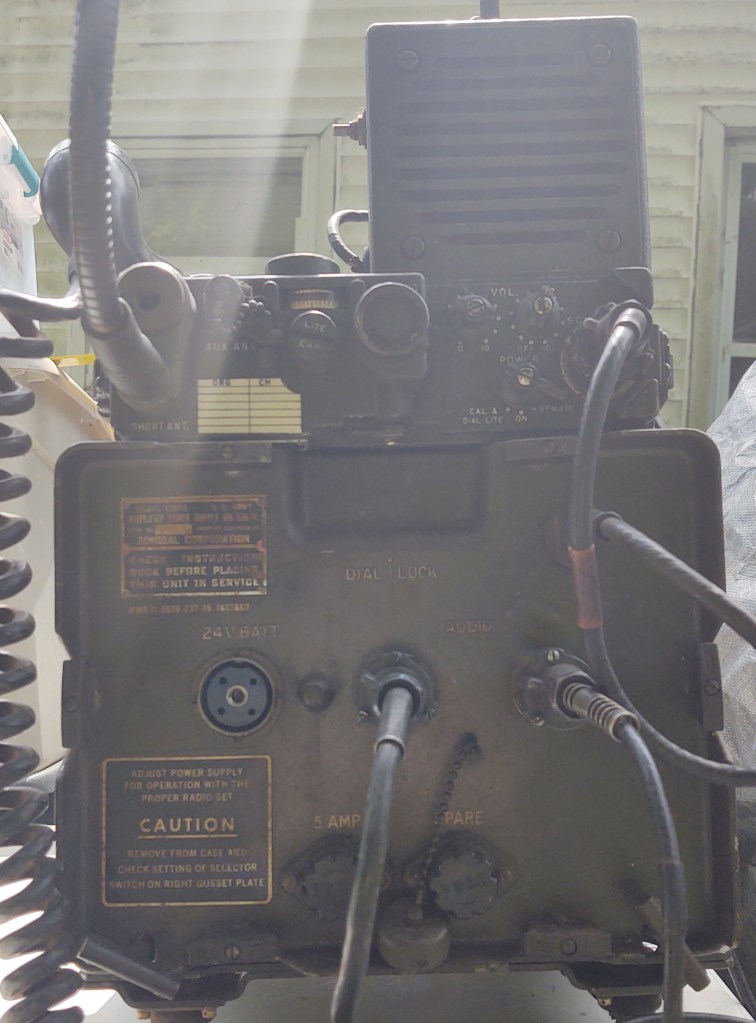
I previously set up static displays. This year will be different as I’ll have a military shortwave receiver listening to broadcasts, and I’ll be in on the air. I’ll have a Part 15 FM broadcast station, “WFDR,” on 99.5 MHz., and a 6 Meter Amateur Radio station on 51.0 MHz. FM with my PRC-25. Hopefully the band will be open. A couple of my fellow ham operators and historians will be on HF. Callsigns and frequencies will be posted on my Facebook feed.
If you’re within driving distance of FDR come visit. My fellow historians do an excellent job of putting this event together. We’re going to have the Big Band Sound Jazz Orchestra playing on Sunday, and other family events over the course of the weekend.
On Memorial Day, 2019 I was volunteering as a living historian for the American Veterans Historical Museum during their annual display at the Franklin D. Roosevelt Home and Library in Hyde Park, New York. I specialize in World War II to Cold War era military communications electronics and test equipment, and curate a small collection of artifacts, ephemera, and memorabilia during events throughout the year. On that day, I was approached by a visitor who wished to make a donation for my displays. The visitor was the daughter of a U.S. Army Signal Corps officer who served in the 23rd Headquarters Special Troops, better known historically as “The Ghost Army.” The Ghost Army was tasked during the Second World War with tactical deception operations in the European Theater of Operations. The lady donated a small assortment of ephemera that belonged to her late father during his time in military service.
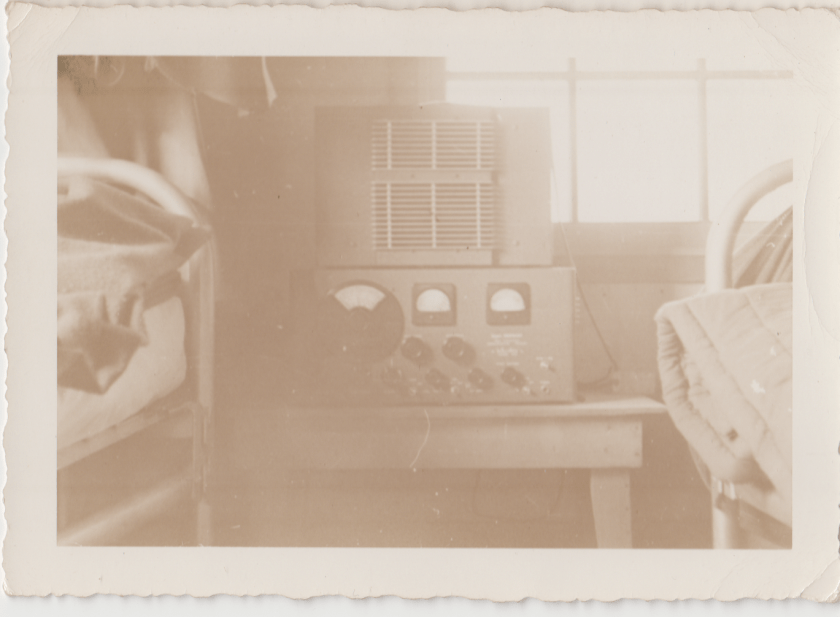
Among the ephemera donated was a 1941 dated photograph of a radio communications receiver identified as a Hallicrafters model SX-25. The SX-25 was first manufactured in 1940 just before the United States entry into the war and was considered state-of-the-art equipment at the time. It was unknown if this receiver was a personally owned item, or military issue.
Among historians, in particular living historians, attempting to portray an individual from a particular timeframe, or historians assembling a display from a particular timeframe, accuracy is essential to provide as realistic a depiction of the timeframe in question. Historians also strive to include donated artifacts in their displays as a means of thanking the donors and showing their appreciation for the gift. In the case of this donation, the donor’s late father was a member of a historically significant military unit from the Second World War, and an artifact from said donation provided a piece of data for which I was unable to find any evidence of prior research. Those two facts alone would be enough impetus for a historian to start working in order to accurately and realistically incorporate the donation into a future display.
In a conversation with historian Bob Allison of the Vintage Radio and Communications Museum of Connecticut, Mr. Allison mentioned how during the Second World War many military officers purchased communications receivers for personal use (Allison Interview). This is confirmed, albeit almost 50 years later, by my own experience. When I was on active duty during the beginning of Operation Desert Shield and Desert Storm in 1990, I purchased a shortwave radio receiver in order to stay apprised of current affairs when domestic news coverage was found to be lacking. Regardless of the SX-25’s official status, two facts are certain. The first is that it is apparent that the receiver was significant enough to the officer that it warranted being photographed. The second is that the receiver appears in some historical context, however small, related to the U.S. Army Signal Corps during the Second World War, and is therefore a worthy topic of research.
Hallicrafters was one of the first defense manufacturers of the Second World War, and their contribution to the war effort in the production of communications equipment is well documented. What is not well documented is the status of the Hallicrafters SX-25 as a military issue item. I posit that despite the lack of official documentation, the Hallicrafters SX-25 saw military service during the Second World War in a secondary or auxiliary role.
The role of Hallicrafters and the use of their products by the United States military during the Second World War is beyond dispute. Historian Chuck Dachis, the radio hobby’s recognized expert on the company and its products, wrote that “There was a shortage of military radio equipment and tremendous government demand for electronic equipment of all types. Many of the existing Hallicrafters products and designs were pressed into military service” (Dachis 9). During the war, Hallicrafters advertised their status as a manufacturer of radio communications equipment for the U.S. military and solicited service members to write about their experiences working with Hallicrafters military equipment (Radio). The Hallicrafters SX-25 was introduced in 1940 and produced until 1945 (Dachis 40). That places the production period of the receiver right at the time of U.S. involvement in the war. With the years of introduction and production coinciding closely with the year of entry into the war, combined with the early wartime stop-gap issuance of any suitable receiver design into military service, there is a strong argument towards the use of the SX-25 into military service. Further evidence however is still required for one to be certain.
One of the earliest pieces of potential evidence I encountered regarding the SX-25’s service as a military radio is a film. The United States Army Air Forces First Motion Picture Unit produced a training film, Resisting Enemy Interrogation, directed by Robert B. Sinclair. The SX-25 makes a cameo in the film as a prop used by the antagonists in the film (Sinclair). The film provides evidence that the SX-25 was procured by at least one element of the United States military, but still leaves the question of whether it was a general issue item. The United States Army Air Forces First Motion Picture Unit had a specialized function, and as a result would have been able to procure items outside regular channels in order to accomplish their mission.
The SX-25 did not just appear on the big screen. During the Second World War the U.S. Army Signal Corps used an image of a Hallicrafters SX-25 as an element in a recruiting advertisement, shown in Illustration 2 (U.S. Army). This advertisement was aimed at young men who possessed knowledge in radio and electronics. The SX-25’s presence as a prop in an official recruiting advertisement lends further credence to the SX-25’s status as a military-issue radio.
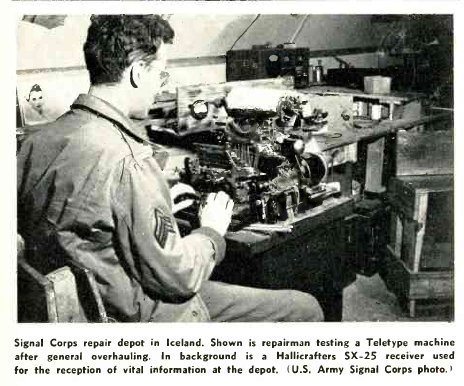
The most compelling piece of positive evidence collected by the author is an official U.S. Army photograph of a Signal Corps repair depot in Iceland during World War 2. This photograph, shown in Illustration appeared in the December 1943 issue of Radio magazine and identifies the repair depot’s radio receiver as a Hallicrafters SX-25 “used for the reception of vital information at the depot” (Radio 50). While a documented official photograph helps support an argument towards its status in military service, there should also be further supporting documentation that would define a particular item as official military issue.
The preceding evidence, despite its compelling nature, is actually of secondary veracity, and does nothing to decisively cement the status of the Hallicrafters as an official piece of military issue equipment. The receiver’s appearance among the personal effects in the living quarters of a soldier belonging to a specialized unit, its appearance in a training film, its use in an advertisement, and even its appearance in an official US Army Signal Corps photograph leave out one piece of data that is considered the primary source of authority on all things military issue.
There is a singular piece of data that will without a shadow of a doubt prove an electronic communication device’s status as official military issue. That item is a designation in the Joint Army-Navy Nomenclature System (JAN), now known as the Joint Electronics Type Designation System. Under this system, an item is giving a unique designator for identification (Mote). Once a piece of equipment is given a designator, an entire logistics chain is attached to the equipment/designator combination. Among other items in the chain is the creation of official operation and maintenance documentation for said piece of equipment. The existence of a JAN designator and operation/maintenance documentation would be the definitive evidence of a receiver’s status as an official issue item.
Hallicrafters was known for producing official issue items that were given a JAN designator in World War II. Among receivers, the Hallicrafters SX-28A, introduced in 1944, was adopted by the US Military and given the JAN designator of AN/GRR-2 (Dachis 42). The SX-25, if it were official issue, would have been given a similar designator starting with “AN/GRR.” Technical manuals would be written detailing the proper operation and maintenance for the soldiers responsible for working with and on a particular piece of equipment. Other technical manuals would be written cataloging the equipment being used by military forces. This documentation would further cement the status of a piece of equipment as an item of official issue.
I first consulted a World War II vintage War Department Technical Manual that would have provided evidence of the SX-25 receiver’s status as an official issue item. The 1944 TM 11-227 Signal Communication Equipment Directory – Radio Communication Equipment is “a condensation and compilation of data pertaining to Signal Corps radio communication equipment” (War Dept. preface). TM 11-227 documents the existence of electronic communications equipment in service as of the date of its publication. After consulting TM 11-227, I was unable to locate any mention of the SX-25 in the content of the manual.
I then searched for evidence regarding the status of the SX-25 in the 1945 War Department Field Manual FM 21-6 List Of Publications For Training. This manual was created to “provide a list and index of War Department training publications” (War Dept. 4). As with TM 11-227, I was unable to locate any mention of the SX-25 in the text. It should be noted that I did find other commercial radios manufactured by both Hallicrafters and other companies that were granted a JAN designator and noted as official issue. The civilian identity of these radios was easy to determine, so it stands to reason that the SX-25, if given a JAN designator, would also been easy to locate in the documentation. This lack of evidence argues heavily towards the Hallicrafters SX-25 Communications Receiver not being an official issue item of electronics equipment.
The SX-25 lacks a JAN designator. It also lacks a citation in TM 11-227 and lacks evidence of documentation in FM 21-6. These three items provide compelling evidence that the Hallicrafters SX-25 Communications Receiver was not an official issue military radio during the Second World War. This data, however, does not preclude instances of the Hallicrafters SX-25 being used in military service, in particular by units with a specialized mission. The lack of a JAN designator also does not rule out a particular piece of equipment being used as a stop-gap measure during the early stages of a conflict before the supply chain can provide official issue material.
In addition to documentation showing a Hallicrafters SX-25 in the possession of a Signal Corps officer assigned to the highly specialized 23rd Headquarters Special Troops “Ghost Army”, it also makes three other documented appearances in official US Army media. It makes the appearance in a recruiting advertisement for the US Army Signal Corps. It has a cameo in a film produced United States Army Air Forces First Motion Picture Unit. It lastly appears as a piece of equipment in an official US Army Signal Corps photo of a repair depot, and is specifically mention by name. Given this evidence, despite the lack of official documentation, the Hallicrafters SX-25 saw military service during the Second World War in a secondary or auxiliary role.
While the Hallicrafters SX-25 saw military service during the Second World War in a secondary or auxiliary role, this may not have been the case regarding the artifact that prompted this paper. The particular SX-25 shown in the illustration appears to be situated between two bunks. That places it in a barracks or junior officers living quarters. When this item of data is combined with the 1941 year of the picture, the 1940 year of introduction for this model, and the historical fact that the United States did not enter World War II until late in the year on December 8th, 1941, I believe that this particular SX-25 was a personal radio belonging to the officer.
One universal task of all historians, professional or amateur, is to properly document and preserve the past so it may be used as a learning tool for future generations. To achieve this end, the historian often engages in research. This research may be in regard to a minor, seemingly unimportant, but previously untouched matter such as a seemingly mundane artifact. Whatever the research might be, it helps fill in one more piece of the puzzle that is the past. If said research enables the historian to assemble an informative and educational presentation, then all the more to help the historian educate and perhaps enlighten the public. As a result of this research, I will be displaying the ephemera along with a collection of related artifacts at the Franklin D. Roosevelt home and library on Memorial Day, 2022. A Hallicrafters SX-25 will be the centerpiece of that display.
Works Cited
Allison, Bob. Personal interview. 2 Apr. 2022.
Dachis, Chuck. Radios by Hallicrafters®. Schiffer Publishing, 1999.
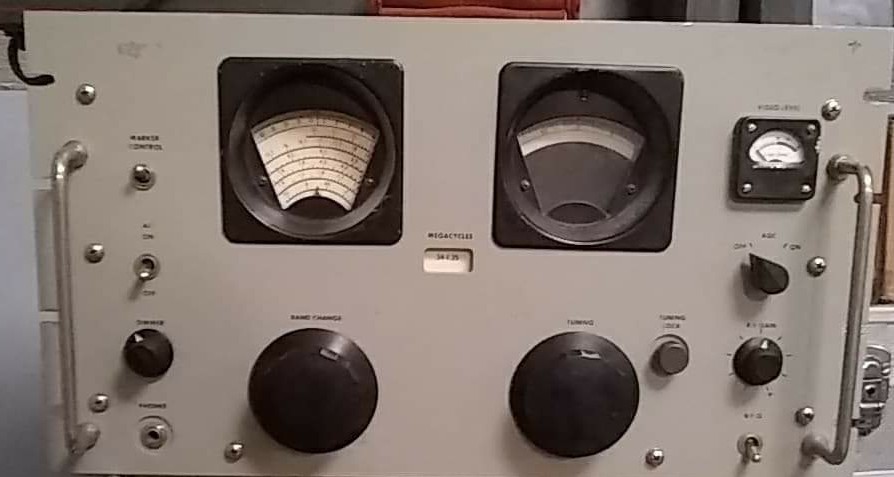
Found this interesting receiver at the most recent Meriden, CT Hamfest last October, and since the price was right hauled it home with me. Why did it catch my eye? For starters, the construction is a dead giveaway that it is a commercial/mil-spec receiver of 1960s or so vintage. Second, the radio had no identifying markings, and no apparent evidence at first glance of being debadged. That is sometimes an identifier of equipment that saw clandestine service in its past life. Third, there was some circuit modules marked as “video converter” which had piqued my curiosity. Finally, if I was a little more awake that morning, I might have recognized the front panel as that of some variant of the Hammarlund SP600 which did see extensive government service. Regardless, it was a mil-spec HF receiver, probably a Black Radio, the price was right, and it was something you normally don’t see at a local hamfest. Once I got home, a Google image search found identical units, and identified it as being an NSA-issue R-1511/GR. Further Google searching discovered that a fellow hobbyist had scanned and uploaded the manual.
From what I discovered online, the R-1511/GR was developed for the National Security Agency in 1968, and was based on the Hammarlund SP600. It saw service until at least the mid 1980s, and based on my research appeared to be part of the AN/GSR-4Store and Forward Environmental Collection System. With this system, wideband RF spectrum was recorded to magnetic tape for later analysis. While this is an easy task these days for any hobbyist with a PC, free software, and an SDR such as the Lime or HackRF One, the NSA was doing this in the 1960s.
Like a lot of gear at hamfests these days, this receiver was from a silent key’s estate, and its specific history, and that of the silent key, is uncertain. He was possibly in the ASA, NAVSECGRU, or maybe even USAFSS as they would have been the service members familiar with this system. Did this piece of gear listen to the Soviets, the Chinese, or someplace in Central or South America before retiring to civilian life in some former veteran’s ham shack? We’ll never know, but we can safely guess that it was interesting in a “behind the curtain” manner.
The frequency coverage of this radio goes up to the 6 Meter ham band (50-54 MHz.), and the SP600 is still a good performing receiver by today’s standards. This unit, when not being used for displays, is going to be parked on the center of the 6m beacon subband to monitor and record VHF propagation conditions.
One of the visitors to my display at last Memorial Day’s FDR event was a lady who was happy to see the Signal Corps. represented there. In conversation, she told me that her father had served in the Signal Corps with the Ghost Army during World War II. We chatted a bit, and she went to go see the rest of the event. This was a common occurrence that weekend, veterans and their families stopping by to thank us for honoring those who had served, and to share stories. You cannot have history, after all, without the story.
The next day, I left my display for a bit to go have lunch with Carol, and upon my return, one of my fellow historians told me a lady had stopped by looking for me. Shortly afterwards, my visitor from yesterday stopped by holding a ziplock bag of ephemera which belonged to her father from his time in the Signal Corps, and that she wished to donate to the museum. I thanked her, and took down her information so she could be properly credited when it appears in a future display.
Upon examination, the bag held some 1950s Signal Corps documents telling me her father served past the war, two pieces of insignia, and two pictures dated 1941 on the back. One was a picture of the squad room our soldier was billeted on, and the other was a radio he owned while there. Intrigued, I set out to identify what model it was.
As a ham radio operator with some boatanchor experience, I recognized the radio as a Hallicrafters. Hallicrafters was one of the first boatanchors I was exposed to, courtesy of a 1983 or 1984 article in CQ Magazine featuring Chuck Dachis, who is the hobby’s expert on them.
The date on the back of the picture was 1941, so I knew the radio was made before then. Consulting the pictures and dates in Radios By Hallicrafters, identification was narrowed down to either an SX-24 Skyrider Defiant or SX-25 Super Defiant. Both radios are very similar in appearance, but the most notable difference to me is that the earlier SX-24 has control settings sikscreened directly on the case for the two controls directly below and to the right of the frequency display, whereas the newer SX-25 only has a single line at 12:00 with the settings on the knobs themselves. Examination of the above picture shows the latter, which makes this unit an SX-25.
I don’t know if the SX-25 was actually used in military service. The next model Hallicrafters made, the SX-28, did see use as the AN/FRR-2. Available online documentation does not show any indication it was, and I’m guessing that the SX-25 in the picture was the soldier’s personal radio.
In 1941, just before our entry into World War II, the SX-25 was Hallicrafters’ newest model. When war was declared, the US Army pressed into service all sorts of radio gear, so maybe a few SX-25s did make it into inventory. Either way, this soldier thought enough of the SX-25 to buy one once he was at his duty station, or bring it from home. If anyone reading this has documentation or other evidence showing that the SX-25 was used as an issue radio, please send me an email.
Just recently, I was at a local Old-School Army/Navy store in Newington, CT called Military Specialties. I was introduced to them by a friend in the early 1990s after having moved to Connecticut for my first electronics job after having come off active duty. On the shelf in the back among the other collectibles was a very clean looking Hallicrafters SX-25, among a few other vintage shortwave receivers. Inquiring about it, I learned that Bill, one of the owners, was a shortwave aficionado, and that we both served in the same National Guard unit, albeit 40 years apart. I bought the SX-25, but there are still some other clean-looking vintage shortwave receivers there for anyone looking. They’ll probably need a little servicing and aligning, but afterwards they’d be a nice addition to someone’s radio collection.
NEAR-Fest and the Nutmeg Hamfest are this weekend. I’m thinking both would be a good venue to look for the PM-23 speaker that’s in the picture with the radio.







 Tom's Tech and History Blog