


A few fellow historians and I from The Duffle Bag and Associates, and The American Veterans Historical Museum put together a little display for Guardian Revival’s 10th Annual Veterans Appreciation Chow Down last month.

A few fellow historians and I from The Duffle Bag and Associates, and The American Veterans Historical Museum put together a little display for Guardian Revival’s 10th Annual Veterans Appreciation Chow Down last month.
https://www.guardianrevival.org/calendar/2024-11-10-veterans-chow-down
If you are a Putnam County, NY veteran you are invited to attend. Please RSVP as per their web page.
Click here for last year’s museum display.

I always do very well finding stuff here.

https://www.fdrlibrary.org/events-calendar
Memorial Day Weekend Event:
World War II Military Displays
Time: 10:00 a.m. to 4:00 p.m.
Location: FDR Library Great LawnOn Saturday, May 25 and Sunday, May 26, 2024, in honor of Memorial Day Weekend, the Great Lawn in front of the Franklin D. Roosevelt Presidential Library and Museum will take on the appearance of a World War II encampment with WWII Military Displays.
Period military vehicles of all sizes and soldiers in battle dress will be on hand to share their love of World War II history. Free public event.
The Duffle Bag and Associates, along with the American Veterans Historical Museum and a host of other living historians, are doing Memorial day again at FDR, sponsored by the library. I’ll be there, weather permitting, with a small display.
Normally I do a Cold War display at FDR, despite it being predominantly a World War II themed event. There are a few of us who do a post-1945 displays there. This year however marks the 80th Anniversary of the D-Day landings in Normandy, France, and my wife and younger daughter are planning on cosplaying Rosie the Riveter (their first time going in costume for this event), so I figured it would be a good idea to have a complementary costume. I don’t think, however, that I’ll be doing an ETO impression.
Despite the amount of media play that D-Day receives, there were also other pivotal events that happened elsewhere in June, 1944. Allied forces had captured Rome in the Mediterranean Theater on June 4th. June 5th was the first B-29 bombing mission, Operation Matterhorn, in the CBI theater. June was also the beginning of Operation Forager in the Pacific Theater.
Locally speaking, many National Guard and Reserve units in this area served in the Pacific or CBI Theaters. The 77th Infantry Division (USAR), 43rd Infantry Division (CTARNG et al), 27th Infantry Division (NYARNG), 118th Observation (now Airlift) Squadron (CTANG), and 333rd (now 131st) Fighter Squadron (MAANG) all served in the Pacific or CBI Theaters. Honorable mention goes to the 98th Infantry Division (USAR) that was slated for the cancelled Operation Olympic, and served occupation duty in Japan after the war.

Last November I set up a small display with a few fellow enthusiasts and historians at the Veterans Chow Down held by Guardian Revival.

I usually display Cold War era radio communications equipment, and while that gear was well represented this time around, I also added some helmets, ephemera, and insignia to the display. Among the artifacts were a few Vietnam War era shoulder sleeve insignia (SSI), and a circa 1971 plaque from the 1st Calvary Division, US Army that had images of various subordinate units’ distinctive insignia. The insignia in the display prompted a few conversations from Vietnam War veterans who recognized their outfit’s patch from back in the day, and were glad to see their old outfit represented.
Based on the feedback I received from attendees, and a desire to run as light as possible (no R-390s or R-1511s LOL!) I decided to put together some Riker mounts of Vietnam War SSI for a future display. I decided to use full-color merrowed SSI for the display as they are still common and relatively inexpensive for the most part. A collector should be able to put together this display at any decent old-school army/navy store. At present my go-to place is run by my friends Brian and Jeanie, the father/daughter duo of The Duffle Bag in Patterson, NY. That’s where I do the vast majority (about 90%) of my militaria shopping. I’ve been going there since the early 1980s when the store was known as The Militaria Mart in Brewster and then Carmel, NY. It was in fact Brian who steered me towards insignia when I started collecting military memorabilia in elementary school. The Duffle Bag is at present one of the oldest and sadly one of the last old-school Army/Navy stores left in the Hudson Valley, NY region.


I referred to my copy of the late Shelby Stanton’s Vietnam Order Of Battle. Stanton’s book is one of my go-to references. I discovered that I was most of the way towards having a complete collection of authorized, merrow-edged, full-color Vietnam War SSI. The missing insignia were procured down at The Duffle Bag, along with a large Riker mount. I started arranging the patches, and discovered I need a few more mounts to cleanly display the complete set.

First Row (Left to Right): 1st Armored Division, XXIV Corps, 2nd Armored Division, 196th Infantry Brigade, 11th Infantry Brigade, 199th Infantry Brigade, 198th Infantry Brigade, 1st Calvary Division.
Second Row (Left to Right): 18th Engineer Brigade, 20th Engineer Brigade, Capital Military Assistance Command, Criminal Investigation Division, 38th Infantry Division, 101st Airborne Division (Airmobile/Air Assault), 18th Military Police Brigade, 11th Armored Calvary.
Third Row (Left to Right): US Army Special Forces, 124th Transportation Command, 5th Transportation Command, 125th Transportation Command, 82nd Airborne Division, 173rd Airborne Brigade, 4th Transportation Command, 44th Medical Brigade.
The infantry units will get separated into another Riker mount, possibly two of them if the arrangement looks crowded. The other units will be arranged in their own mount. I might also add a few twill cut-edge subdued SSI.
Full-color SSI were used on the green Army Dress Uniforms from World War 2 until 2015, and started again in 2018 with the retro-WW2 style uniform. Collectors are still finding NOS boxes of WW2 era SSI. Late 60s to present day merrow-edged SSI are common and you can buy them from 50 cents to a few dollars each depending on where you’re getting them, and which unit you’re buying. If you are a military history buff with an interest in collecting memorabilia, insignia is a good, inexpensive way to start that doesn’t take up much space. The World War 2 stuff is beginning to gain some serious value. Common patches are hitting the $10+ range compared to their cost back in the 80s and 90s. The more common late Cold War to present day stuff is still reasonably priced, and a good place to start.
The US Army Wikipedia entry shows an overview of branches of service and major units along with their respective insignia. If you delve into the individual unit wiki entries you will discover what subordinate units are part of the division/command/brigade/et al and see the unit crests (distinctive unit insignia) of the various regiments. Some of those regiments go back to the American Revolution. After collecting Vietnam War era SSI, you could work on regimental DUIs with Colonial American roots. You could also switch services and collect Navy ratings or Air Force unit patches. Yeah, there’s a lot you can get into, and that’s part of the fun. I’ve been collecting for over 40 years and am not even close to finished. Collecting military heraldry is truly a lifetime hobby.
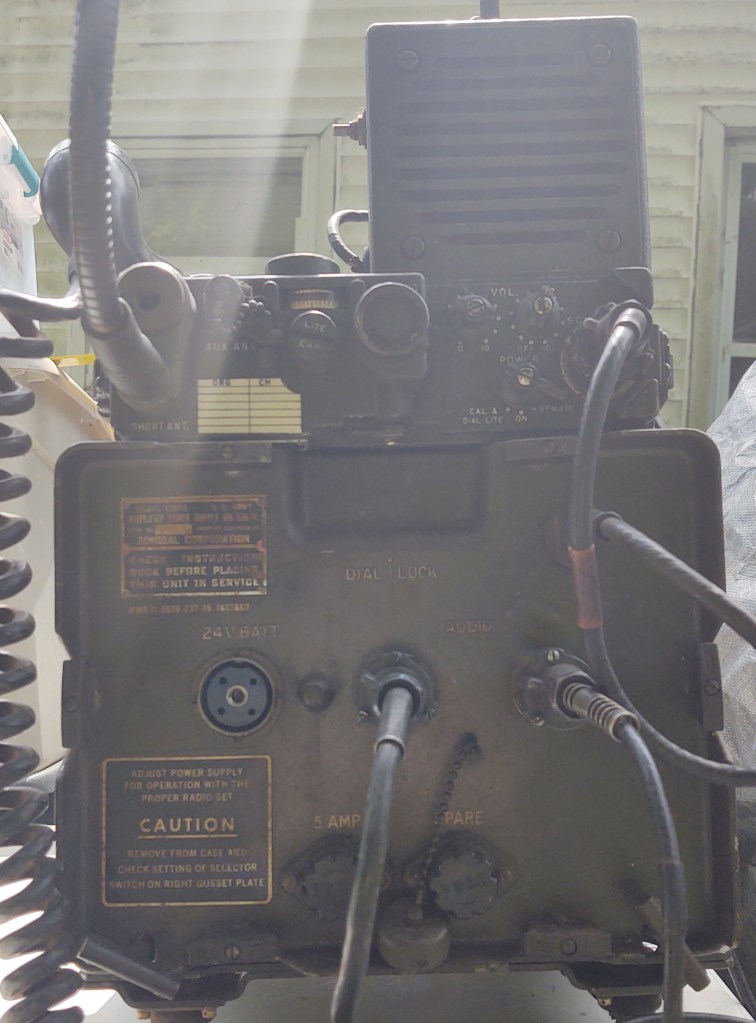
Memorial Day is next weekend, and I’ll be displaying some Cold War communications equipment at the FDR Home and Library in Hyde Park, NY sponsored by my friends and fellow historians with The Duffle Bag & Associates. I’ve done this event since I moved back East, save for when it was cancelled due to COVID.
I previously set up static displays. This year will be different as I’ll have a military shortwave receiver listening to broadcasts, and I’ll be in on the air. I’ll have a Part 15 FM broadcast station, “WFDR,” on 99.5 MHz., and a 6 Meter Amateur Radio station on 51.0 MHz. FM with my PRC-25. Hopefully the band will be open. A couple of my fellow ham operators and historians will be on HF. Callsigns and frequencies will be posted on my Facebook feed.

If you’re within driving distance of FDR come visit. My fellow historians do an excellent job of putting this event together. We’re going to have the Big Band Sound Jazz Orchestra playing on Sunday, and other family events over the course of the weekend.

I missed the past two years for Memorial Day at FDR because of COVID. Things settled down enough this year that the National Archives and the National Park Service opened it up for my associates and I this year. This time around I planned for an even bigger display than in 2019.


A line of rain and thunderstorms came through Saturday, making that day a wash (no pun intended) for the most part. Sunday was much better. I didn’t make it Saturday because of the weather, but got there early Sunday morning and set my display up.
This year I displayed three tables of radio communications and electronics test equipment covering a time span from World War II to the Cold War eras. I also set up a Part 15 FM radio station, “WFDR,” on 99.5 MHz. that played some 1940s era music for a short while.

In this picture there is a Cold War era Soviet R-105m VHF transceiver, a PRC-25, PRC-75, PRC-74, WW2 Navy/Marine Corps TBY, WW2 R-156 sonobouy receiver, and WW2 BC-1000/SCR-300.

This picture shows an early WW2 Amateur Radio station consisting of a Hallicrafters SX-25 (which did see military use during WW2) and a Utah Junior HF CW transmitter, along with a reproduction foxhole radio using an old “blue blade” safety razor blade. Unfortunately I didn’t have the space to set up a decent antenna to run the foxhole radio. Two of next years’s goals include getting reception for the foxhole radio and getting a vintage Amateur Radio station on the air.

The bottom right shows a small collection of electronic test equipment. We have a radar IFF test set, oscilliscope, VOM meter, and RF SWR/power meter.


One of the visitors to my display at last Memorial Day’s FDR event was a lady who was happy to see the Signal Corps. represented there. In conversation, she told me that her father had served in the Signal Corps with the Ghost Army during World War II. We chatted a bit, and she went to go see the rest of the event. This was a common occurrence that weekend, veterans and their families stopping by to thank us for honoring those who had served, and to share stories. You cannot have history, after all, without the story.
The next day, I left my display for a bit to go have lunch with Carol, and upon my return, one of my fellow historians told me a lady had stopped by looking for me. Shortly afterwards, my visitor from yesterday stopped by holding a ziplock bag of ephemera which belonged to her father from his time in the Signal Corps, and that she wished to donate to the museum. I thanked her, and took down her information so she could be properly credited when it appears in a future display.
Upon examination, the bag held some 1950s Signal Corps documents telling me her father served past the war, two pieces of insignia, and two pictures dated 1941 on the back. One was a picture of the squad room our soldier was billeted on, and the other was a radio he owned while there. Intrigued, I set out to identify what model it was.

As a ham radio operator with some boatanchor experience, I recognized the radio as a Hallicrafters. Hallicrafters was one of the first boatanchors I was exposed to, courtesy of a 1983 or 1984 article in CQ Magazine featuring Chuck Dachis, who is the hobby’s expert on them.
The date on the back of the picture was 1941, so I knew the radio was made before then. Consulting the pictures and dates in Radios By Hallicrafters, identification was narrowed down to either an SX-24 Skyrider Defiant or SX-25 Super Defiant. Both radios are very similar in appearance, but the most notable difference to me is that the earlier SX-24 has control settings sikscreened directly on the case for the two controls directly below and to the right of the frequency display, whereas the newer SX-25 only has a single line at 12:00 with the settings on the knobs themselves. Examination of the above picture shows the latter, which makes this unit an SX-25.

I don’t know if the SX-25 was actually used in military service. The next model Hallicrafters made, the SX-28, did see use as the AN/FRR-2. Available online documentation does not show any indication it was, and I’m guessing that the SX-25 in the picture was the soldier’s personal radio.
In 1941, just before our entry into World War II, the SX-25 was Hallicrafters’ newest model. When war was declared, the US Army pressed into service all sorts of radio gear, so maybe a few SX-25s did make it into inventory. Either way, this soldier thought enough of the SX-25 to buy one once he was at his duty station, or bring it from home. If anyone reading this has documentation or other evidence showing that the SX-25 was used as an issue radio, please send me an email.
Just recently, I was at a local Old-School Army/Navy store in Newington, CT called Military Specialties. I was introduced to them by a friend in the early 1990s after having moved to Connecticut for my first electronics job after having come off active duty. On the shelf in the back among the other collectibles was a very clean looking Hallicrafters SX-25, among a few other vintage shortwave receivers. Inquiring about it, I learned that Bill, one of the owners, was a shortwave aficionado, and that we both served in the same National Guard unit, albeit 40 years apart. I bought the SX-25, but there are still some other clean-looking vintage shortwave receivers there for anyone looking. They’ll probably need a little servicing and aligning, but afterwards they’d be a nice addition to someone’s radio collection.
NEAR-Fest and the Nutmeg Hamfest are this weekend. I’m thinking both would be a good venue to look for the PM-23 speaker that’s in the picture with the radio.
James Burrowes OAM
Keeping History Alive - 4th NY Regiment & 4th Battalion Royal Artillery
Honoring the past through excellence in the present.
Kerosene lamp restoration and other curious things.
electronics, open source hardware, hacking and more...
Photoblog of Joshi Daniel
Creating art, poetry, and fiction.
Amateur Radio stories, articles, projects, and more!
Stories with a Twist
Fresh hacks every day
This WordPress.com site is Pacific War era information
The world's oldest and greatest name in pulp
The mindless witterings of an author at work - and play.
International wordsmiths of repute
Better than you expected.
Jake Spurlock as something subtle from the heart of Utah.
write. collaborate. win.
but do you have the courage to start?
Just another WordPress.com site
Jason Scott's Weblog
A site of endless curiosity
because anything is possible with Charisma
Just another WordPress site
Fishing, Hunting and Do It Yourself stuff
Writings of Michael Morgan
Adventures of an Imperfect Man In Search of a Handmade Life
forwards, backwards, sometimes sideways
Learn How To Survive Any Disaster Situation
"God bless it and keep it wild"
Bushcraft, wilderness survival skills and nature
Life's Little Moments
everyday and outdoor gear close to tactical and emergency
Using technology to be prepared
A few of my favorite photos
Warden of Words // Shaper of Stories
Hiking and exploring Nature's finest sculpturings
 Tom's Tech and History Blog